In this report: The effects of a blue wash on oil, Hormuz now, The Glut 2027, Commitment of traders report, trade and trade spreads check in.
Last week. Brent -13.32% (-$15.11) O $111.69 H $112.41 L $93.22 C $98.32
Articles
A rare glimpse inside the high-risk, high-reward Hormuz trade
Oil Prices Continue to Fall as Democratic Sweep Shakes Energy Markets
Cross the Red Sea, Shippers Email Houthi Rebels. Read Their Inbox.
The Global Oil Glut Returns as High Prices Crush Demand
UAE Mulls Third Crude Oil Pipeline to Avoid Strait of Hormuz
Why is Iran exempting India, China, Qatar, Iraq from Hormuz restrictions?
The Little-Known Chinese Bank in the Middle of Iranian and Russian Money Flows
6 Things to Know About Yashar Party Leader Gadi Eisenkot
View
The oil patch just lifted out the administration that promised drill baby drill. Texas turned blue for the first time in about 40 years. It really takes a mess to do something like that. The war risk premium is getting priced out. As of Monday 9 Nov, Brent trades back at the upper risk premium floor - see Trade.
The pure impact of this midterm blue wash on the energy patch is currently about negative 15% /$17 since election night. Outside of price measurement, It is simple to see that the war agenda will now have its wings clipped. Trump will no longer have the optionality he enjoyed since February. He will also be without his true wingman Netanyahu, if Eisenkot is successful in his current task of forming a new Israeli government. It remains to be seen if a new government will form with or without Netanyahu. keep it in mind though, that Eisenkot is far from taking a dovish stance on Gaza and The West Bank. He could in fact be a worse option for hope of peace in the region.
The Democrats took the Senate - at least 54 seats on CBS’s count - flipping Texas, Ohio, Iowa, Kansas, North Carolina, Maine and South Carolina. CBS and CNBC both called the House for them too. The new Congress isn’t seated until January. The veto protects executive actions, and overriding one takes 67 senators - 54 is 13 short. LNG export approvals sit with the Department of Energy, not Congress. Nothing about US production, permitting or export policy changes this side of Christmas, and very little changes after it. The equities priced it anyway. The S&P Energy index fell 4.77% and WTI traded $87.35 on Thursday (OilPrice, 5 Nov). Newsquawk reads the loss of legislative backing for “drill, baby, drill” as hitting BP BP 0.00%↑ , Shell SHEL 0.00%↑ and TotalEnergies hardest.
Congress does get one lever from January, and it’s oversight of the war. Rep. Yassamin Ansari filed six impeachment articles against Defence Secretary Pete Hegseth back in April, citing the 28 February strike on a girls’ school in Iran that killed 168 people (CBS News, via IBTimes UK). Hakeem Jeffries says the new majority will “run Pete Hegseth out of town”.
The one Texas result that touches barrels is the Railroad Commission. Democrat Jon Rosenthal beat Republican Bo French 53% to 46% for the seat Jim Wright lost in the Republican primary run-off, and he’ll be the first Democrat on the commission since the 1990s (KPRC, 4 Nov). Republicans keep a 2-1 majority, so the commission’s direction doesn’t change. Rosenthal’s agenda is abandoned wells, gas weatherization and wastewater disposal - and wastewater disposal is the one that feeds into Permian operating costs.
In short, the blue wash is a clear public rejection of higher energy costs that come on the back of a pointless war. This has cost the Republican Party everything.
Hormuz
Back in May (‘The New Normal) I wrote that Iran was charging tolls on the world’s most critical waterway. Six months on, there is a list of fee paying clients.
Iran now lets ships bound for India, China, Iraq and Qatar through. It isn’t free: Indian and Chinese ships pay Iran a transit fee. Qatari ships don’t pay (Al Jazeera).
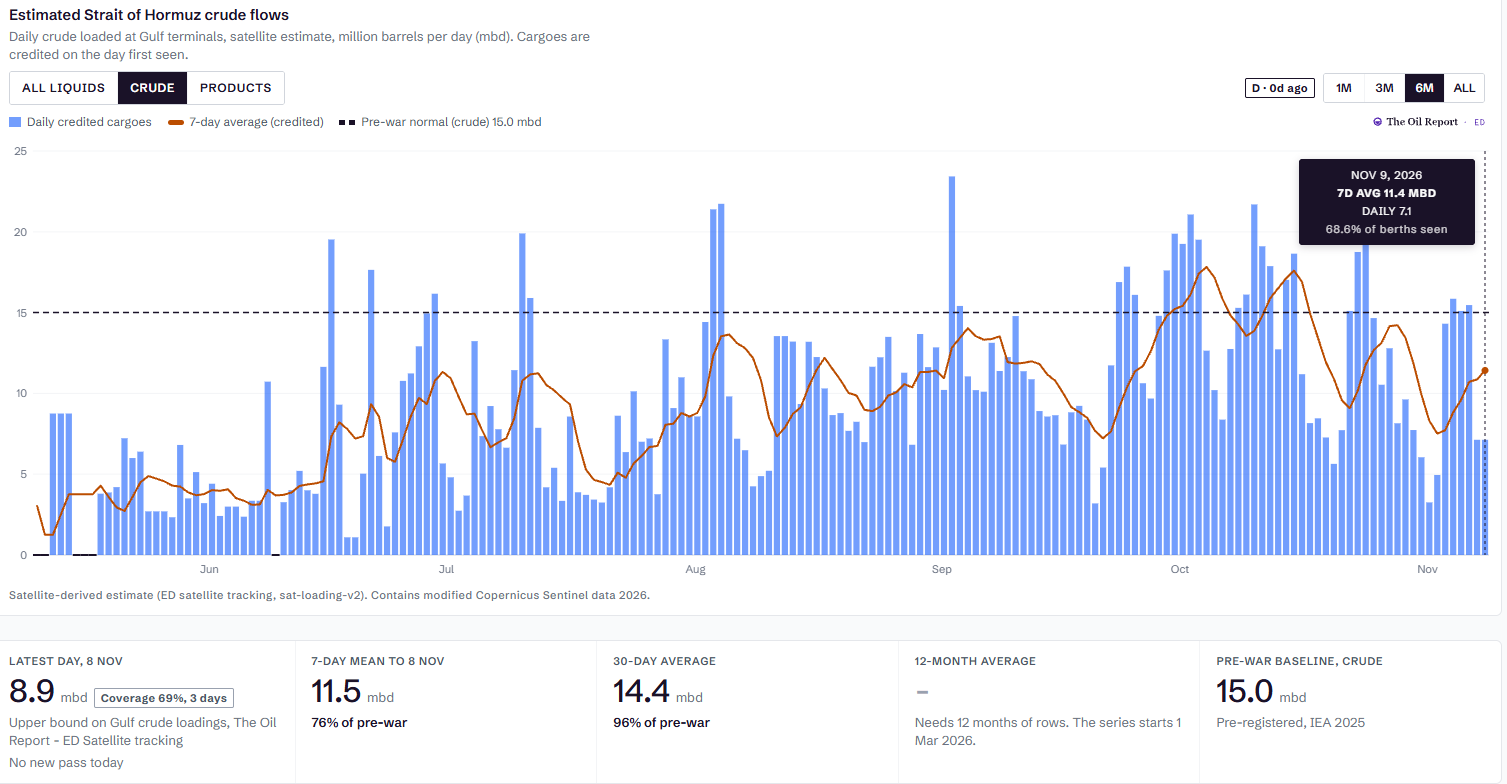
Kpler has 10.23 mb/d of Gulf crude through the strait in October, more than half of it going to China and India. Iraq’s flows are up from 1.69 to 2.65 mb/d, and Qatar’s LNG is moving again. Even so, Gulf exports are still about 4.6 mb/d short of pre-war on the IEA’s numbers. Whatever comes back on Tehran’s terms and for a fee, and that fee now sits in the landed cost of every Gulf barrel in Asia. A US election doesn’t touch it.
The UAE is looking at a third pipeline around the strait, a 100 km run to the Gulf of Oman coast (Gulf News). No capacity, no FID, no date. Nothing moves through it this winter.
On the satellite system we have, we are seeing 8.9mb of crude transited yesterday, with the average 7d at 11.5mb. Again, remember Vitols 14mbd level? So supply and balance risk remains underpriced on a market that is down $17 on a blue wash. Republican, Democrat, it doesn’t matter. THE DAMAGE IS DONE!
Enter the glut 2027
Then the headline of the week: “The Global Oil Glut Returns as High Prices Crush Demand”. The demand side is real. The IEA has 2026 demand down 2.6 mb/d, and Q4 down 2.5 mb/d year on year. Kpler has refined products demand down 2.4 mb/d in 2026. OPEC, in its September MOMR, still had 2026 demand growing 0.4 mb/d. That’s a 3 mb/d argument between two agencies about the same year.
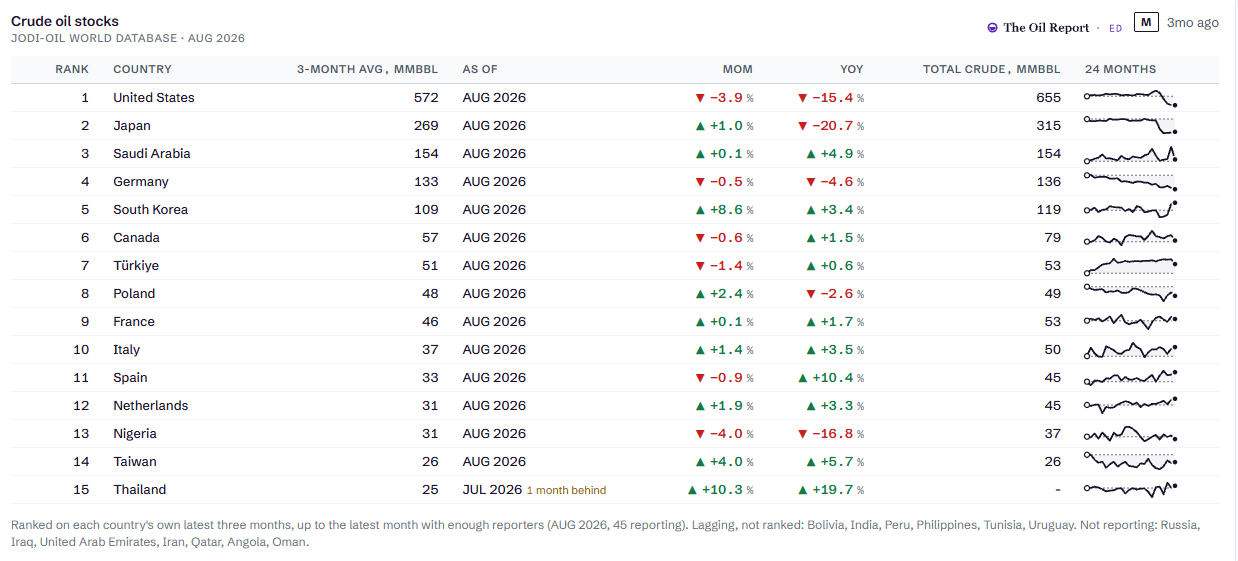
Now the stock side. The IEA has global inventories 509 mb below pre-war at the end of September. A glut is a surplus that builds stocks. Before this one builds anything, it has to fill that hole:
At a 1.4 mb/d surplus, 509 mb takes a year.
At 2.6 mb/d, it takes about six and a half months.
Where would 2.6 mb/d come from? This is the strongest version of the bear case, so let’s run it properly. Gulf supply is down about 4.6 mb/d and demand is down 2.6 mb/d - a deficit of about 2 mb/d. That squares with stocks drawing 509 mb in seven months, about 2.4 mb/d on average. Bring the missing 4.6 mb/d back, keep demand where it is, and the deficit flips to a surplus of about 2.6 mb/d. At that pace stocks are back to pre-war by the middle of 2027.
The curve already prices that. Brent Dec27 settled $80.59 on Friday. The Cal27 strip averaged about $87.90, against the EIA’s $84 for 2027. That’s the October STEO - November’s is out this week. So the back half of next year already carries a glut, and the curve is still less bearish than the EIA.
Three reasons to take this glut hypo as gospel. Demand comes back as prices fall. Every barrel of demand that returns comes off that 2.6 mb/d surplus.
Iran is reopening Hormuz selectively, for a fee, to buyers it picks. The 4.6 mb/d doesn’t come back in one go.
Product stocks refill through refinery runs, not tankers at anchor. China holding its diesel at home and US distillate at 99.3 mb into the winter don’t care how fast crude flows.
That’s why I’m watching the crack and the structure more than flat price.
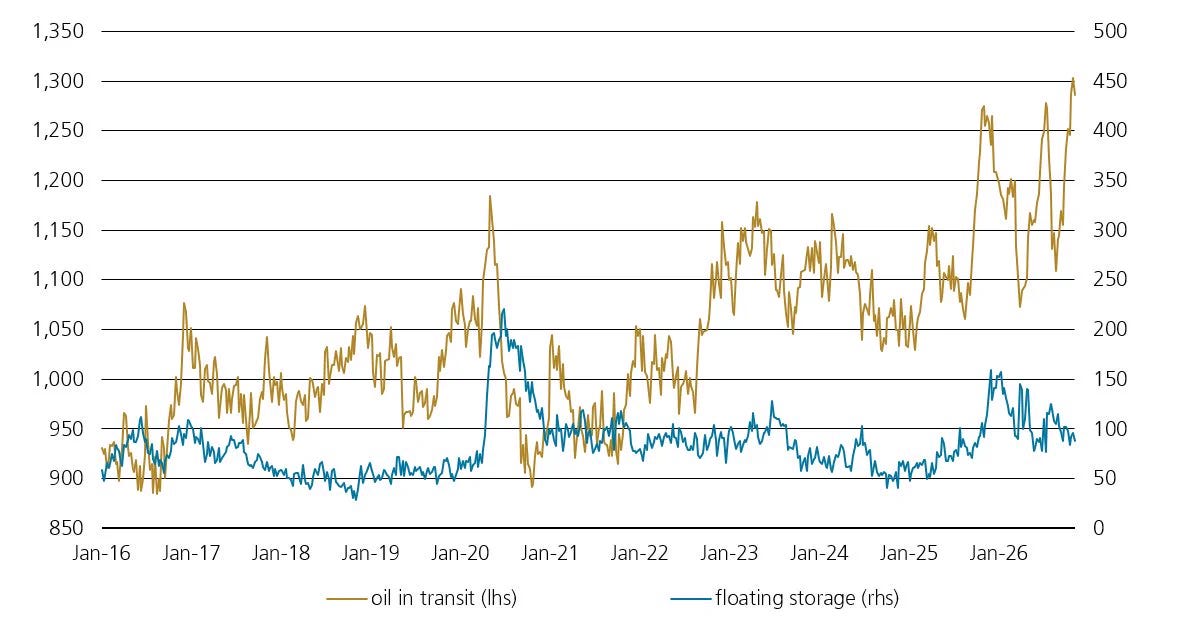
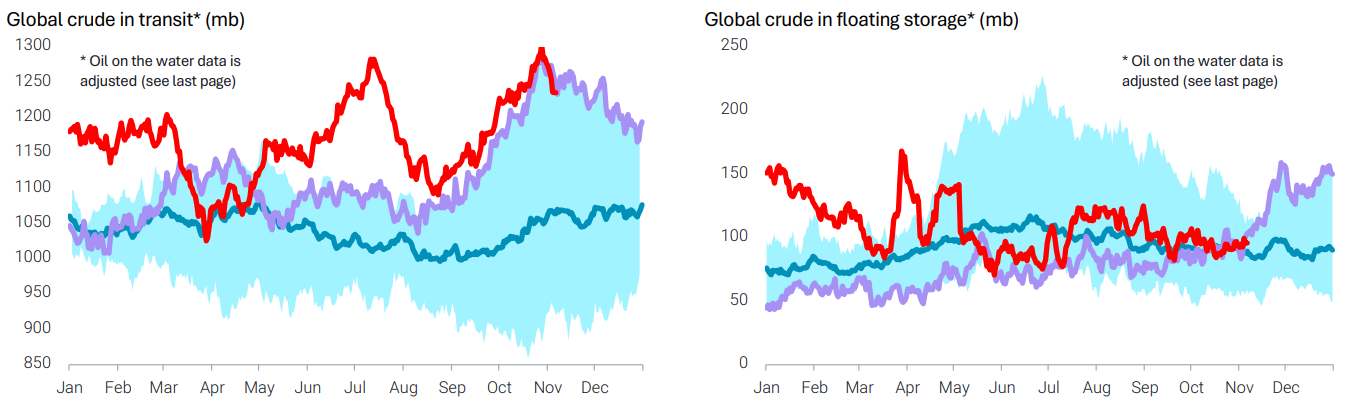

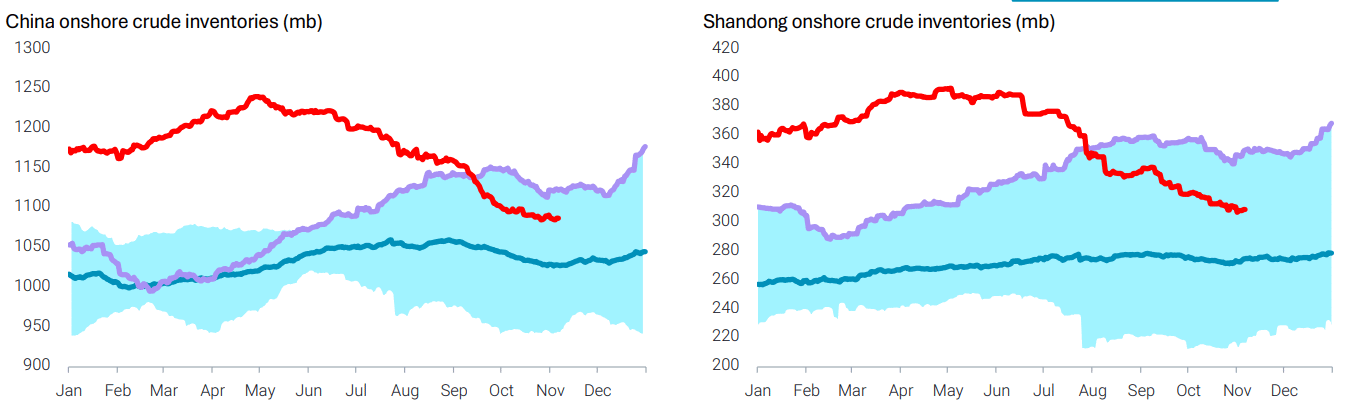
If you remember, China came into this situation building stocks at elevated levels. Turns out the situation they were planning for happened.
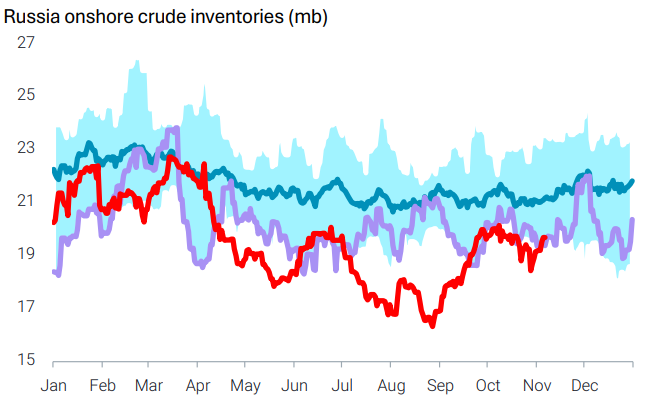
Russia stocks and the ESPO grade shipped out to China during the summer and now those stocks recovered. ESPO shipments covered in my Sept 4th issue ‘The Kozmino corridor’
The Net Net
Commitment Of Traders Report
The combined read.