In this report: Hormuz flows and who carries them, the agency forecasts for 2027 and what the curve already prices, Washington’s “no deal” and Tehran’s reply, US diesel and the Fed, Tier 1 resource and the offshore cycle, Commitment of Traders
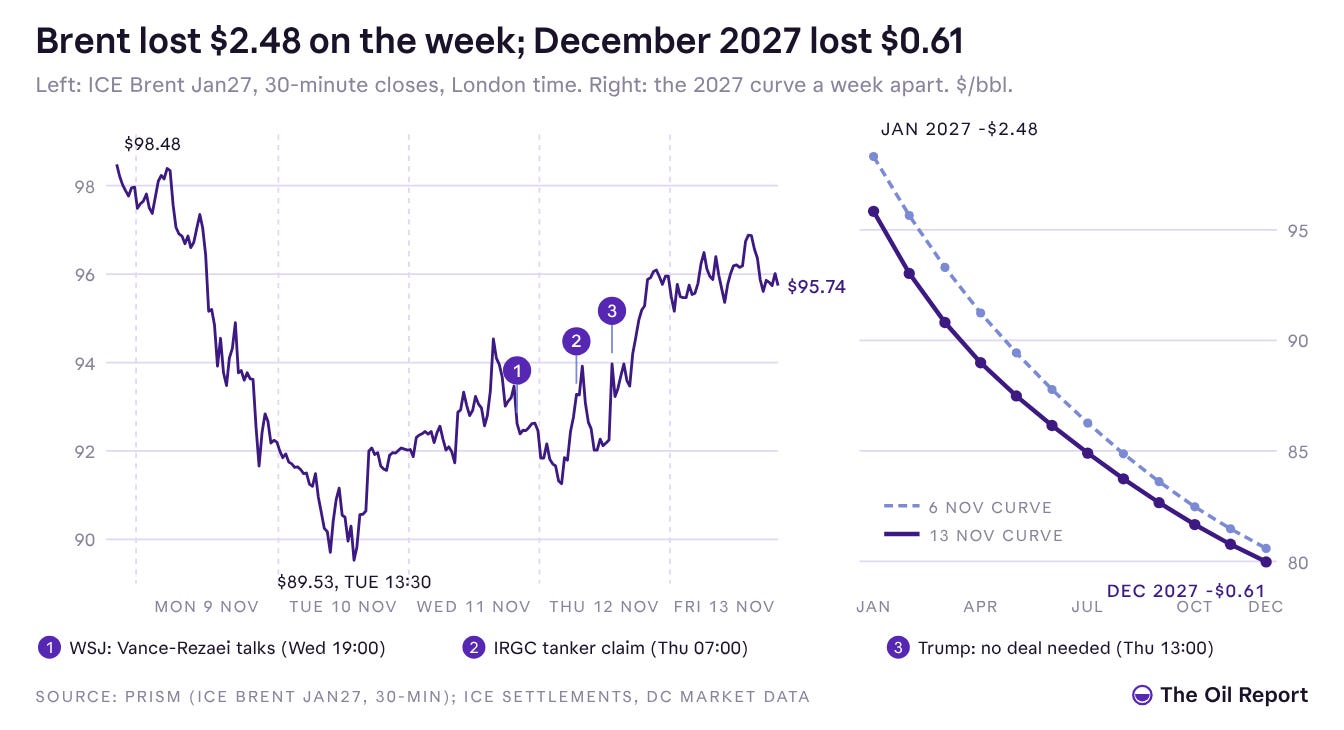
Last week. Brent -2.52% (-$2.48) O $98.20 H $98.43 L $89.16 C $95.84
‘‘The oil price will come back down, but I’m telling you diesel prices are not coming back down anytime soon. You don’t have refining capacity. You’re going to have a lot of oil sitting on ship somewhere, but it’s not going to get processed into diesel anytime soon. That’s what I mean by just because there’s more oil coming out of the Gulf and barrels of oil price, it doesn’t mean energy prices are necessarily going to drop in the near term for everybody else. I just don’t see diesel coming down dramatically because more oil’s coming out of the Gulf. You got to have refining capacity and that stuff’s been seriously damaged around the world and isn’t going to come back soon. So you can’t just look at the price of a barrel of oil. It’s like what do you do with the oil and how is that stuff all being affected?’’
- Christopher J. WallerBoard of Governors of the Federal Reserve System
Articles
Scoop: Israeli spy chief in D.C. as Netanyahu presses Trump to resume war
BP profit hits 18-year high as oil refining margins surge
Whistleblowers claimed key oil tanker rate was manipulated
Vance considers direct talks with Iran hardliner in push to end war
Iran’s Assembly of Experts on leaving the NPT, Al Mayadeen
Trump: “We don’t need a deal with Iran”, Truth Social
IRGC claims explosions on two supertankers in Hormuz, Sabreen, and Fars
View
There are several items to talk about, but none more pressing than two items. Hormuz flows and the Glut forecasting for 2027. In This week, the IEA published its first surplus of the war, and Iran claimed hits on two supertankers in the strait.
1. Hormuz flows
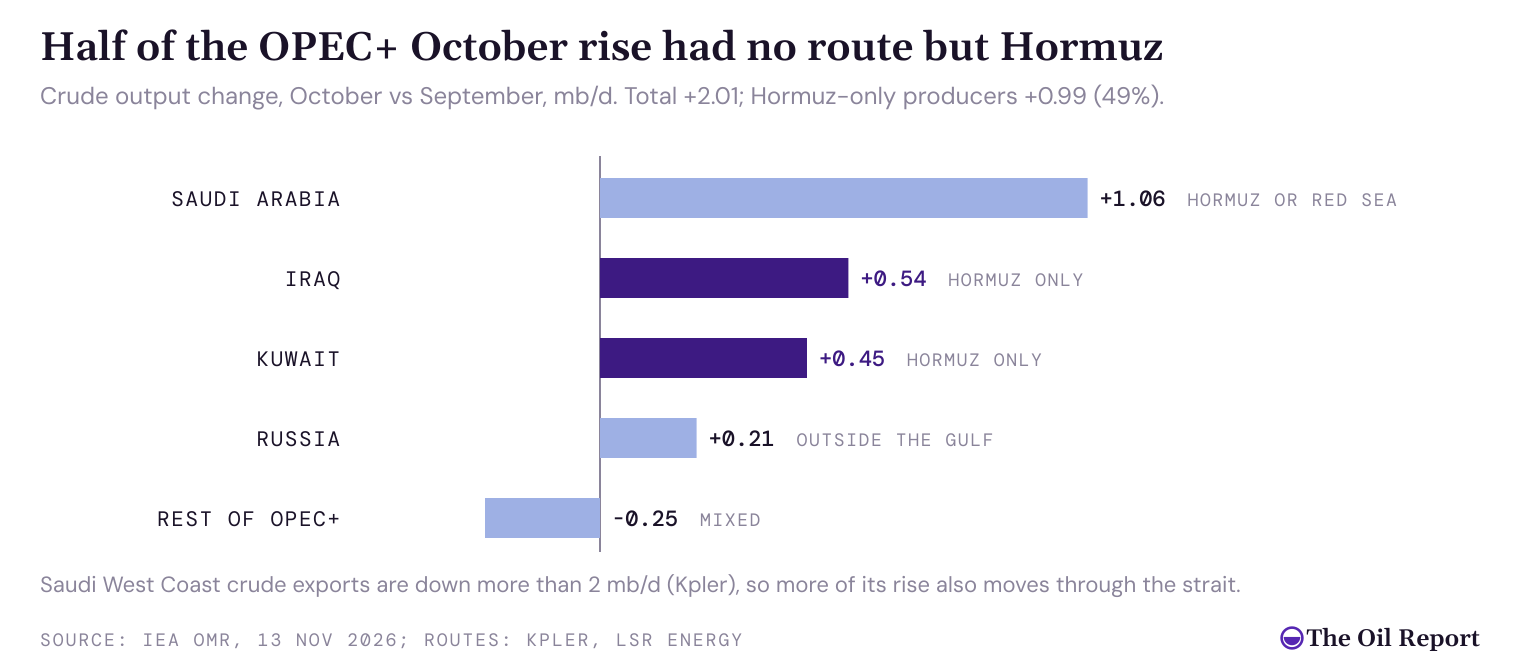
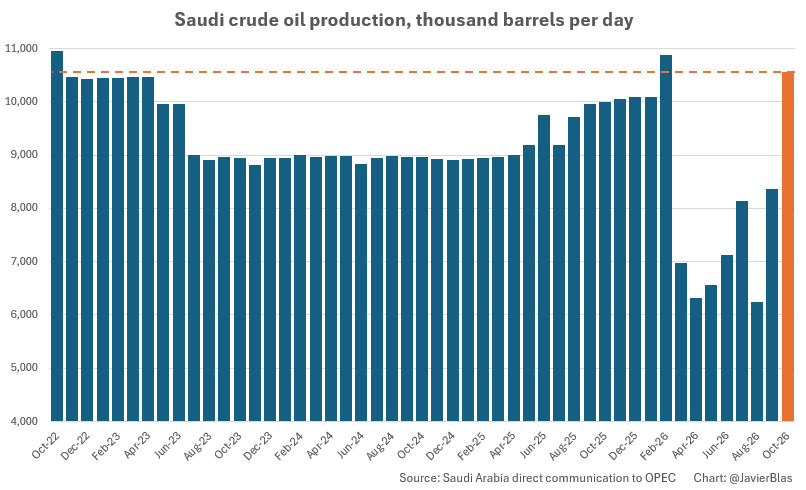
The Gulf’s barrels came back in October. World supply rose 2.3 mb/d to 105.4 mb/d, the first month of the war in which supply beat demand (IEA OMR, 13 Nov). OPEC+ crude rose 2.01 mb/d to 37.72 mb/d, and Saudi Arabia did half of it: 9.99 mb/d against 8.93 mb/d in September. Iraq added 0.54 mb/d and Kuwait 0.45 mb/d. Gulf crude exports reached 15 mb/d, 82% of pre-war (IEA).
Ok, so the volume is back. The route is the question. Kpler puts October Gulf crude through the strait itself at 10.23 mb/d, 42% of it to China and 13% to India (Kpler via Al Jazeera, 6 Nov). Take that from the IEA’s 15 mb/d and about 4.8 mb/d left the Gulf by other doors. That fits what the bypass can carry: Yanbu at about 3 mb/d of wartime loading and the Fujairah line at about 1.8 mb/d. Two sources, so treat the split as indicative, but the capacity check holds.
The unsafe barrel - Petroline/Yanbu
Now look at who added the barrels. Iraq’s October output was the highest since 2022, up 496 kb/d on the month, and Iraq has no bypass (LSR Energy). Every extra Iraqi barrel goes through the strait. Saudi output is technically the highest since February, and without the one-month surge just before the war it is a four-year high (Javier Blas). Yet Kpler data has Saudi West Coast crude exports down by more than 2 mb/d (via Ayuso, may be revised up). Production is not exports. If Riyadh is pumping more and shipping less from the Red Sea, the marginal Saudi barrel is either going east through Hormuz from Ras Tanura or into tanks. The Houthis hit a pumping station in the Yanbu region with a drone on 11 Nov, so the western door is not a safe one either.
November is running hot.
The IRGC claims explosions on two supertankers carrying more than 4 mb (12 Nov). Iran attacked navigation systems on Oman’s Didamar island (Reuters, 11 Nov). On Monday the UKMTO reported a tanker struck by a projectile while exiting the strait, and Iran’s navy said a fourth tanker in 24 hours had been damaged by a mine east of Hormuz.
Who carries the oil has changed too. Tankers with sanctioned-oil histories are taking over Middle East crude exports, Iraq’s especially (JH, 12 Nov). That is the part of the fleet willing to take the risk at the price. The price shows up in three places:
Freight. A cargo loaded in the Gulf of Oman ships to China for about $20/bbl less than one loaded inside the Gulf, and Hormuz broking fees run at 1.25% of the fixture (The Officials, 13 Nov). VLCC rates are ten times a year ago (OPEC MOMR, 11 Nov).
Gulf selling prices. ADNOC cut Murban’s December OSP by $7 to Dubai +$4, Upper Zakum by $4.50 to -$4 and Das by $4 to -$3. Kuwait offers KEC into NW Europe at Dated -$7.05 (The Officials, 13 Nov).
Atlantic premium. Brazilian crude is selling to Chinese teapots at March ICE Brent +$18. March settled $5.03 under January on Friday, so that is about $13 over the front month for a barrel that never goes near the strait.
The war premium has moved out of flat price and into differentials. Gulf grades clear at discounts of $4 to $7; a Brazilian cargo commands about $13 over the front month.
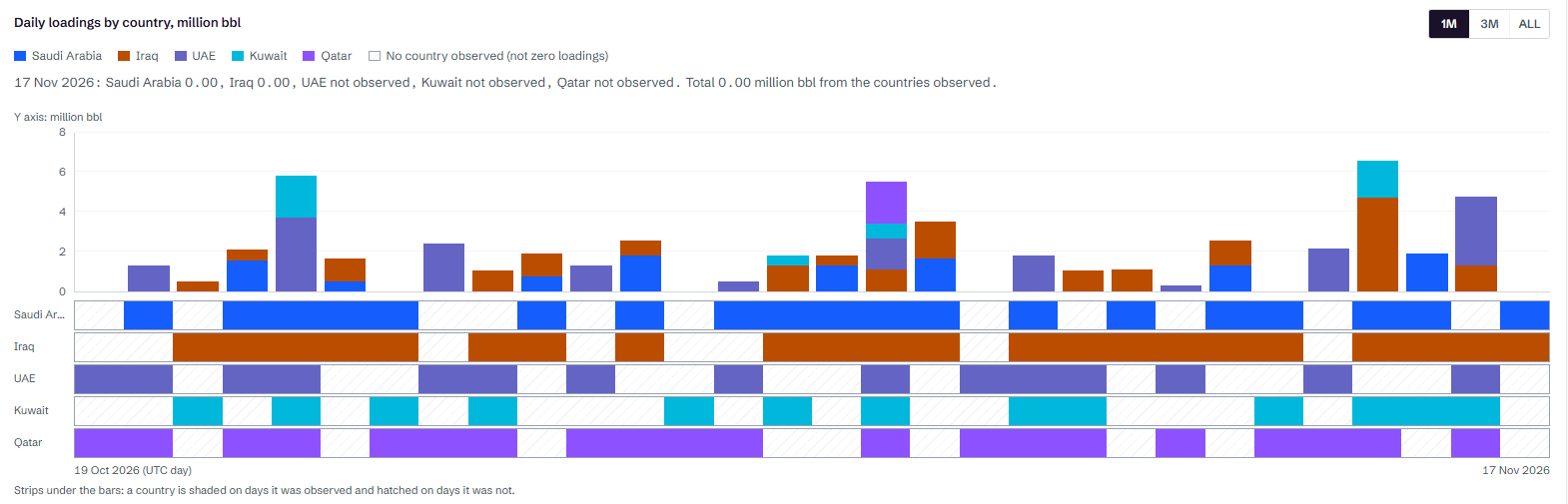
I don’t have a clean November flow number yet; our loading series is still being reconciled. The test for the next fortnight is simple. If attacks keep rising and Saudi West Coast loadings stay down, October’s 15 mb/d will not repeat in November.
2. The 2027 ‘Glut’
The gap between them is demand, and it is almost exactly the size of the glut. OPEC carries 2.9 mb/d more demand growth than the IEA for 2026 (+0.2 against -2.7) and 0.6 mb/d more for 2027. That adds to 3.5 mb/d by the end of 2027, against an IEA surplus of 3.8 mb/d. The supply forecasts sit close together; the glut lives in the demand line. Whoever is right about how much oil demand the war destroyed in 2026 is right about 2027.
Two details in the IEA’s numbers matter for what kind of surplus this is.
Washington
On Thursday the President posted: “We don’t need a deal with Iran. Those days have long since passed. We’ve got their money, Hundreds of Billions of Dollars, and we’ve got their Strait!” Brent Jan27 went from $92.07 to $93.70 within minutes, Dutch TTF gained more than 5% on the session, and Treasuries and equities sold off (Newsquawk, 12 Nov).

The same post told VP Vance to give his “complete and total attention” to corruption in Democrat-run states. A day earlier the WSJ reported Vance was weighing face-to-face talks with Iran’s security chief Rezaei, with Trump’s blessing. Vance wrote to Rezaei in October asking to meet; no date is set. The post reads as that meeting moving down the list.
Two items since point the other way. Iranian media say Washington wants a phased Hormuz agreement: reopen the strait and ease the blockade first, with nuclear issues, sanctions and frozen funds after, and without accepting Iran’s seven conditions up front (ILNA via Newsquawk, 16 Nov). On Monday, reports that the US has no imminent plans to resume strikes took Brent Jan27 down to $91.74. Meanwhile Israel’s Mossad chief is in Washington as Netanyahu presses Trump to resume the war (Axios, 13 Nov). That is three different lines on Iran out of one capital in five days.
Tehran
Tehran’s week moved one way. Iran’s Assembly of Experts says it is studying withdrawal from the NPT and calls it “an unavoidable necessity” (Al Mayadeen, 12 Nov). SNSC secretary Rezaei says Iran is designing nuclear-powered ships and submarines, so none of its enriched material will leave the country (11 Nov). It is the first time since the war began that Iran has named naval propulsion as a use for the stockpile, and it gives Tehran a stated civilian reason to keep that stockpile at home. Rezaei also says Iran will target US bases in Europe if strikes are launched from them, and he discussed a transport corridor and possible Russian gas supplies with Putin.
On the water, Press TV says Iran and Oman have agreed on maritime traffic through the strait, while Tehran repeats that seven conditions must be met before talks and a reopening. Over the weekend Iran launched six drones at Bahrain’s Riffa helicopter base, its first direct strike on Bahrain in several weeks. The line from the Supreme Leader’s representative in the IRGC on Monday: the strait is under full Iranian control and stays closed if the US does not accept the conditions (Fars, 16 Nov).
Diesel and the Fed