



In this report:
Hormuz talks stuck as attacks hit a weekly record, Europe’s thin tank, Asia bending, a warm start to the winter, a light storage build, funds covering, and the COT.
Last week: Henry Hub NG 0.00%↑ -3.2% (-$0.104) to $3.116/MMBtu. Open $3.170, high $3.334, low $3.062, close $3.116.
Last week: TTF $TTF (ICE Endex) +7.5% (+EUR 6.11) to EUR 87.55/MWh, about $28.8/MMBtu. Open EUR 82.00, high EUR 89.02, low EUR 80.63, close EUR 87.55.
“If they comply with our conditions, the Strait of Hormuz will reopen on the sixth day, and negotiations will begin on the seventh day.” - Abbas Araghchi, Iran’s foreign minister, to Tasnim, 18 October 2026
Articles
Europe’s Gas Prices Close to 2022 High as Hormuz LNG Flows Remain Limited
Iran steps up Hormuz surveillance: Attacks soar, oil flows crash again
Iran says Strait of Hormuz reopening, seven-day ceasefire conditions still on the table (CBS News)
Strait of Hormuz attacks surge as Iran steps up campaign against US-backed oil shipping
Goldman sees upside risks (105 EUR!) to its 70 euro TTF gas forecast as Europe stocks run low (investing Live)
China’s Sufficient Gas Stocks Could Ease Winter Supply Concerns
South Korea Turns Back to Coal as LNG Crisis Deepens
Pakistan Faces Winter Gas Shortages if Hormuz LNG Remains Choked
Rebounding Production, Mild Forecasts Send Natural Gas Futures Tumbling (NGI)
Smaller-Than-Expected Weekly Storage Build Lifts Nat-Gas Prices (Barchart)
View
Hormuz: Day One Hasn’t Started
On Sunday, Iran’s foreign minister Abbas Araghchi told Iranian media that Tehran’s conditions for reopening the strait still stand. If the US meets them, he says the strait reopens on day six and talks begin on day seven, however there’s a long way to go before the clock starts. The US must end its naval blockade of Iranian ports and lift oil sanctions. It must also accept a ceasefire on all fronts.
Meanwhile, the attacks keep coming. UKMTO counted at least 10 vessels hit last week, setting a record for number of attacks in a week since the war started in February. There have been 23 attacks now in the month of October.
These recent attacks have been by far the main driver for the +7.5% move on TTF. The Foreign Minister may say the Strait will be opened on day six, but the market is pricing in a much longer disruption to supply than that. Last week we forecasted TTF pushing “higher into winter with a sharp way down”. We have moved up 7.5% since then but does the thesis still hold?
Well, the sharp way down is undoubtedly still possible, the market is expecting extended supply shortages so any reasonable indication of a reopening of the Strait would shock the market and cause an aggressive downwards move. That being said, with a record number of vessel attacks last week, a reopening of the Strait is looking unlikely. The higher into winter also remains true as long as the Strait is closed. I’d expect us to slowly grind towards the EUR 100 mark with any increase in attacks helping it along the way.
Europe is Still Short
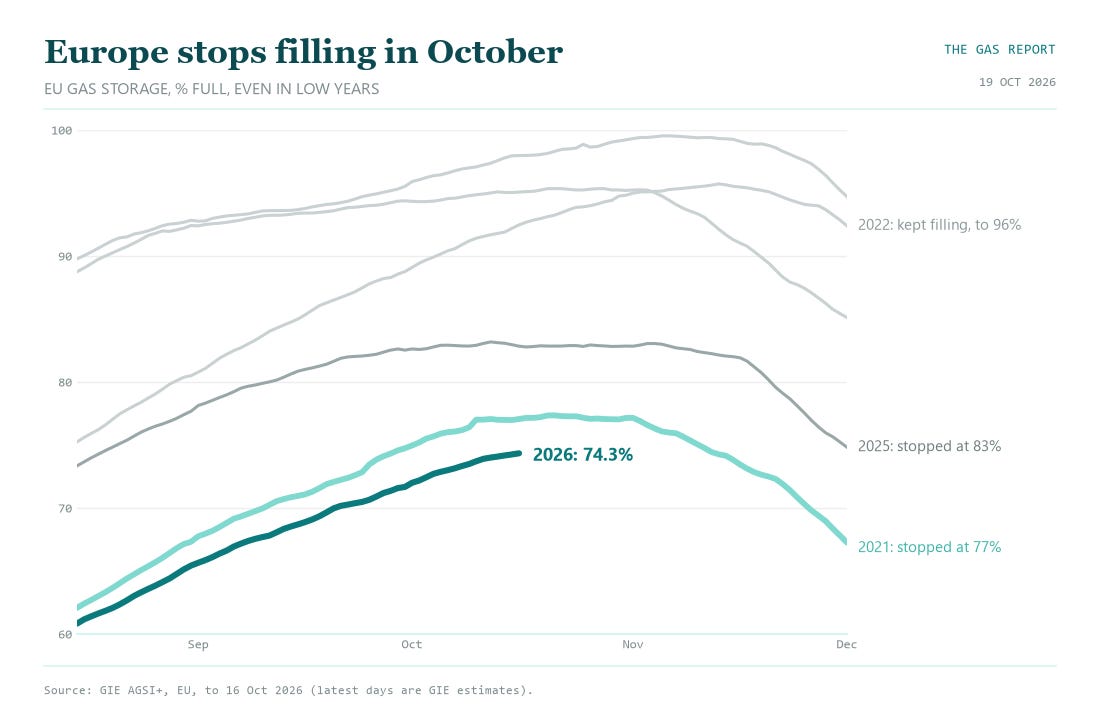
The rise in TTF in the past week wasn’t just fear and anticipation based, Europe’s tank is still low at 74.3% full as of October 16th, below their five-year average of 89.1%. Germany’s tank is even more worrying at 60.7% as of October 16th full compared to its five-year average of 87.8%. This means the Strait being opened would only help so much as the winter shortage is already in place.
Injections are slowing down week on week as they normally do going into winter, the difference is normally, the tanks are full.
Goldman Sachs estimates a price of EUR 105 for TTF would be enough to cut LNG demand outside of Europe, but it seems Asia is bending early. South Korea’s energy minister said this week the country will lean on coal and nuclear this winter and cut LNG use. Pakistan’s LNG chief called the winter “challenging”. China is also likely to buy less LNG, but for a different reason: its storage was 80% full at the end of September, so it can buy less. That frees cargoes for Europe.
Qatar is very little help,with KPLER projecting October exports of 0.6 million tonnes, massively below a pre-war monthly average of 6.6 million tonnes.
Weather: a warm start, not yet a warm winter
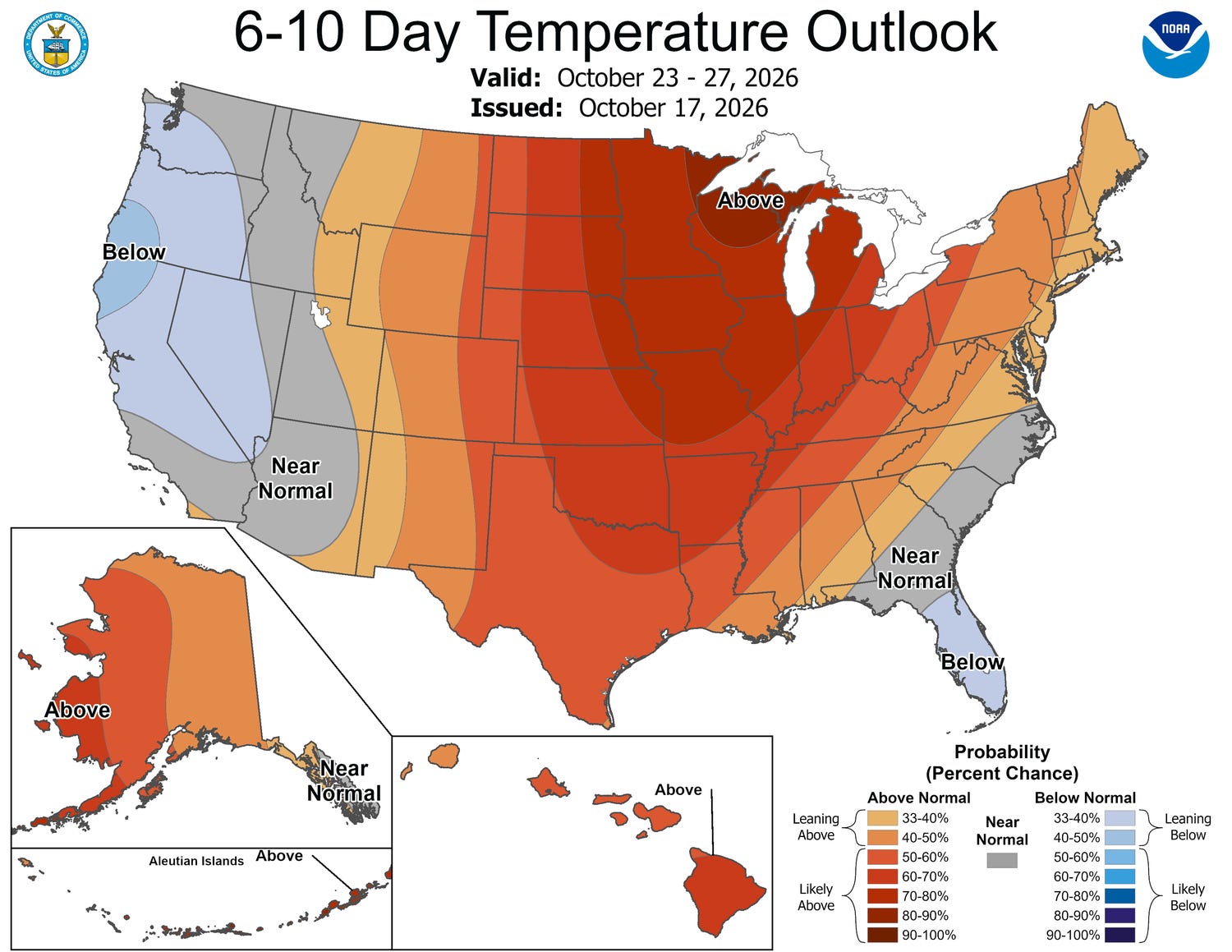
October has been mild. Heating demand ran at about three-quarters of normal in the first half of the month, and NOAA’s latest 6 to 10 and 8 to 14 day outlooks keep above-normal temperatures over most of the central and eastern US into the end of the month.
That tells us less than it looks. Normal heating demand more than doubles between now and mid-November, and a warm October has historically been a weak guide to the winter. El Niño is strengthening, with NOAA giving better than 83% odds of a strong to very strong event through early 2027. The markets are already pricing for a warm winter, so a cold run would cause an aggressive upside move triggering the short squeeze we flagged last week. An even warmer than expected forecast would push prices steadily lower.
EIA Storage
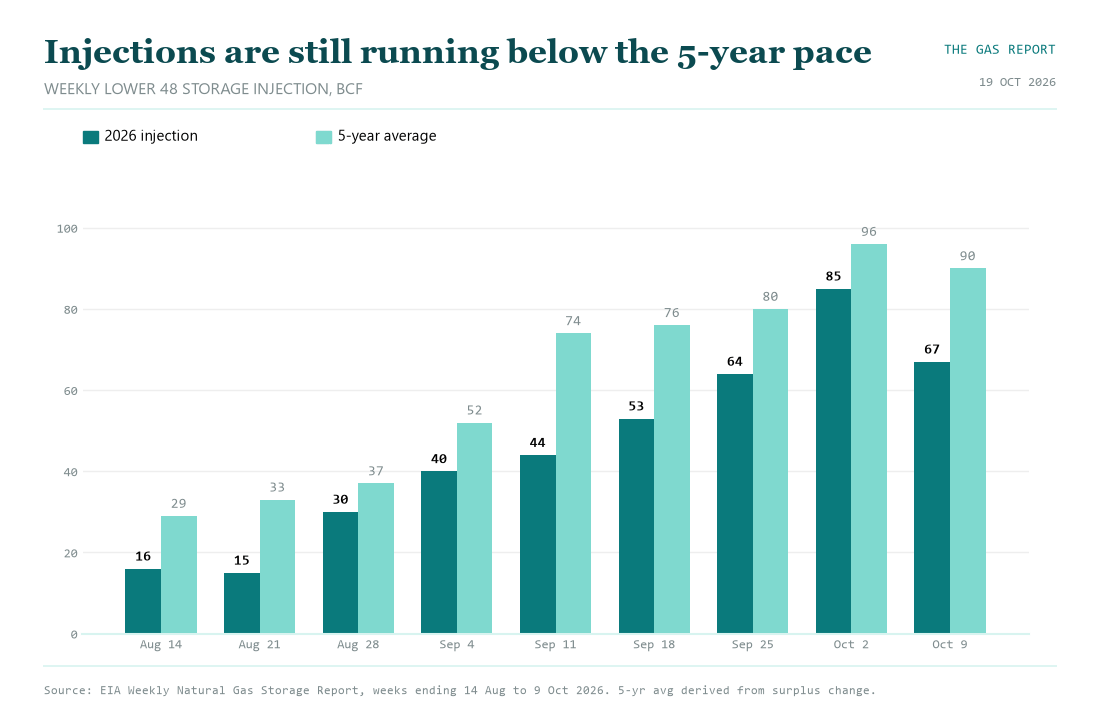
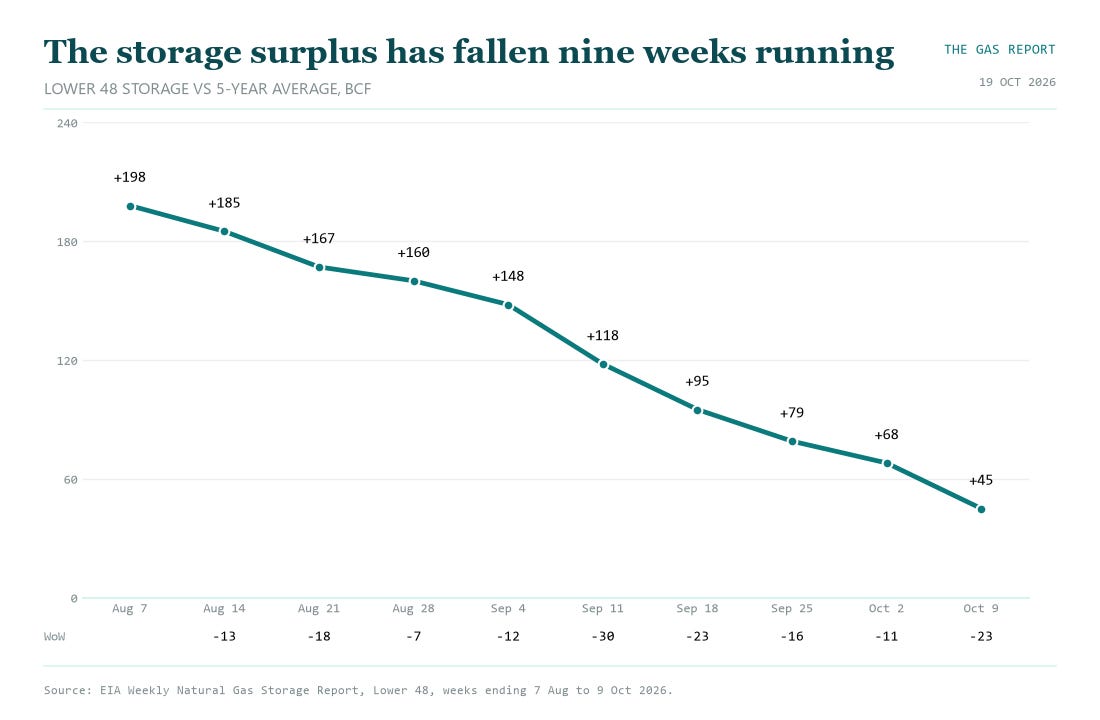
The 67 Bcf build for the week ending 9 October missed the 74 Bcf analysts expected and came in well under the 90 Bcf five-year average. Stocks are 45 Bcf above the five-year average, but that surplus has now shrunk nine weeks running, from +198 Bcf in early August. The leak had slowed, then jumped back to -23 Bcf. Injections have run below normal every week since 14 August. Smaller than expected, smaller than normal: the surplus is still bleeding. More in the EIA Gas Inventory.
The Net Net
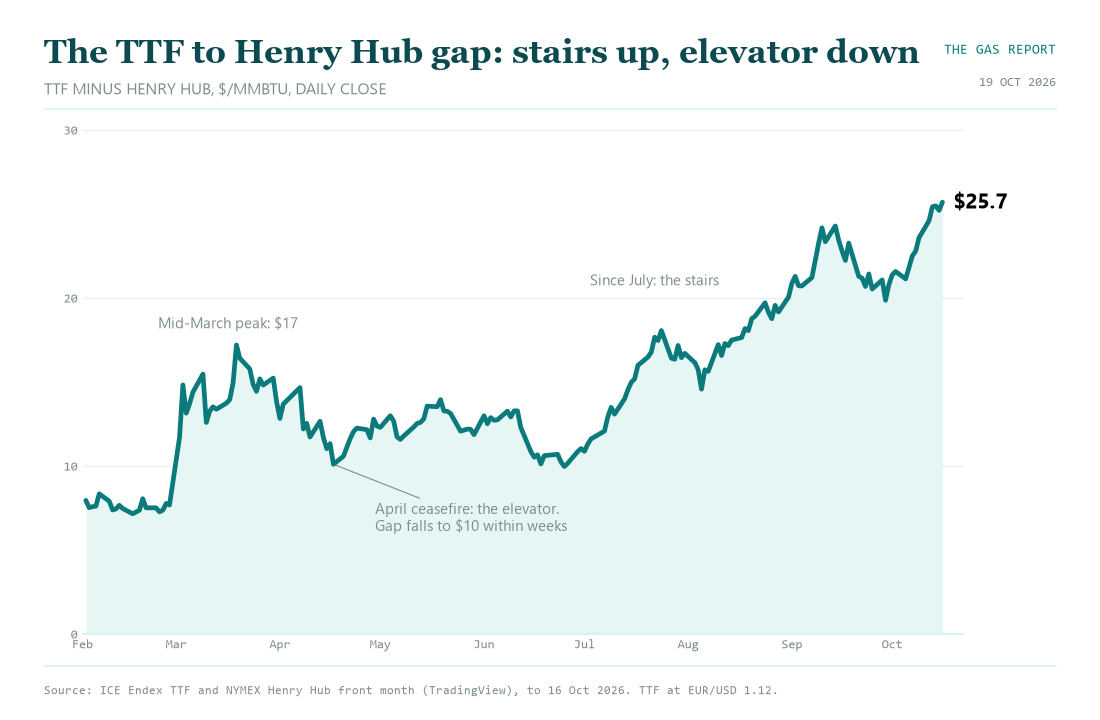
Last week the gap between TTF and Henry Hub was about $24. This week it widened to about $26.
TTF: slow up, fast down. Still higher into winter while Hormuz stays shut. Talks are at day zero, attacks are at a record, and Europe’s tank is 15 points short of normal. A credible reopening is the only thing that changes it, and the bid goes with it.
Henry Hub: range-bound, waiting for the cold. Last week’s lines held. The warm outlook is the lid, one cold spell could blow the lid off. Storage surplus is down to +45 Bcf after nine weeks of shrinking. A close above $3.30 says the squeeze is on, and one below $3.00 says the storm premium is gone.
Calendar: ICE’s TTF COT on Wednesday 21 October; EIA storage on Thursday 22 October (3:30pm Irish); the CFTC COT every Friday; Israel’s election on 27 October; the November Henry Hub contract expiry and Qatar’s next force majeure decision around 28 October; Kpler’s October Qatar export numbers in early November; NOAA’s next ENSO update on 12 November; and the EU’s Russian LNG ban on 1 January.
Below you get the trade guidance for NG that we are looking at, the COT for NYMEX Henry Hub and ICE Endex TTF.
