


In this report: Price has been telling us it’s over. Data is showing a recovering system on crude, but the risks across the complex, especially gas and products, remain tilted to the upside.
Last week. Brent -2.26% (-$1.66) Open $73.90 High $74.90 Low $70.14 Close $71.94
Note: For all paid subs, you get access to our discord, where I publish up breaking news and important snippets during the week. This is market impacting news flow. Here is the link to join. If you do not have a paid sub, you won’t get auto-approved access by the bot. https://discord.gg/jTzQsHNfsY
Articles
Iran’s Revolutionary Guard Fires Missiles at Ships Near Hormuz
ARA fuel oil stocks gain 13% in June
Read the 14-point memorandum of understanding between the United States and Iran
New Energy Order- The Oil Report June 17th 2026
Saudi Arabia considers expansion of oil pipeline to Red Sea, sources say
Saudi Arabia Sells Oil At A Discount For The First Time Since COVID Crash, As China Demand Collapses
Video: IRGC attacks tankers in SOH.
View
I’m going to show below in inventories how the global picture currently looks. This will be significant going forward. The reason for which, is that I suspect we are supplied at one level right now, however should China return to market, this will turn on a dime. Sure, ‘it’s over’ is now fully priced. But in the greater context, we have just departed the zone of first order consequences and are about to enter the second order consequences world. This is where the more interesting trades will be.
Some updates from Monday eve/Tuesday morning.
The IRGC has struck several vessels transiting via the southern route. This has apparently not affect normal passage via the ‘Northern route’, closer to Iranian shores. It is best to monitor this for further escalation through this week. Brent is up 1.2% as of midday London.
Saudi is stated to be expanding its East West pipeline by +2mb/d to increase exports via The Red Sea. I covered this in ‘New Energy Order’ June 17th 2026. Due to the current situation, Aramco had already pushed this pipeline from 5-7mb/d, utilising existing NGL (Natural Gas Liquids?) pipelines that got repurposed. Adding another 2mb/d from my analysis would require an actual new pipe to be laid. If this is the case, we are looking at a 3-5years to completion. The original pipe was commissioned in 1979 in 2yrs, under a different regulatory and standards regime.
One thing to note on the headline of 7mb/d is the true capacity of the pipeline, however the Yanbu port loading capacity is 4mb/d.
Refineries at Yabu can take roughly 1-2mb/d of this. (SAMREF 400k + YASREF 405k + Yanbu refinery 240k). So after refinery draw, its about 5-6mb/d that gets to loading. In short, Yanbu port OR refiners will have to scale up capacity to match with an additional 2mb/d pipeline and none of it happens in the next 3 years.
Now to this week’s report.
Facts.
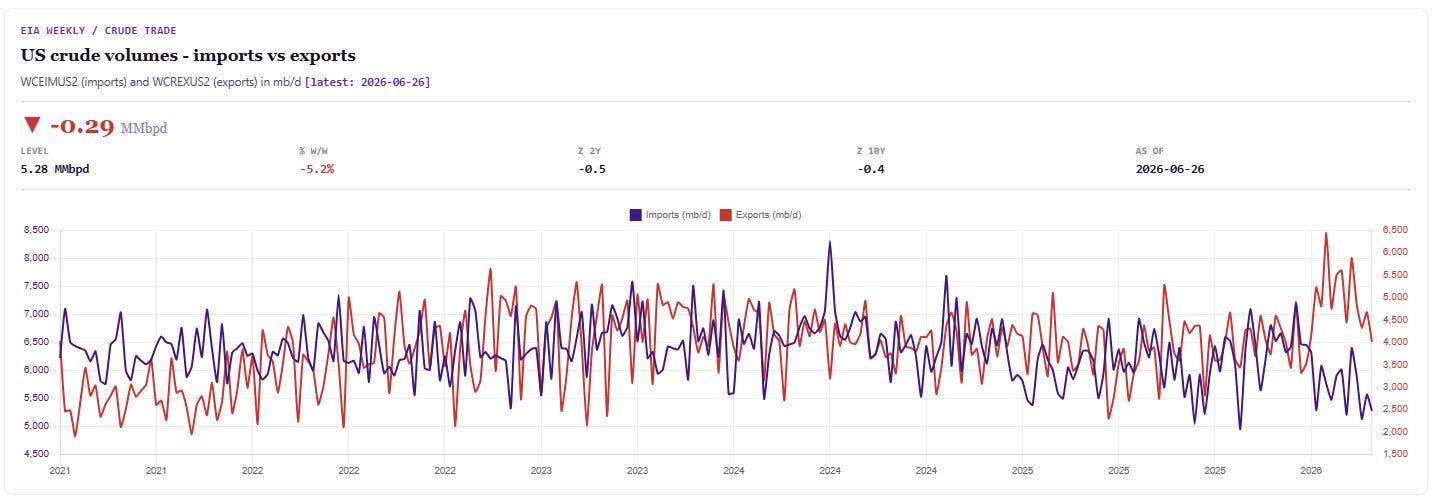
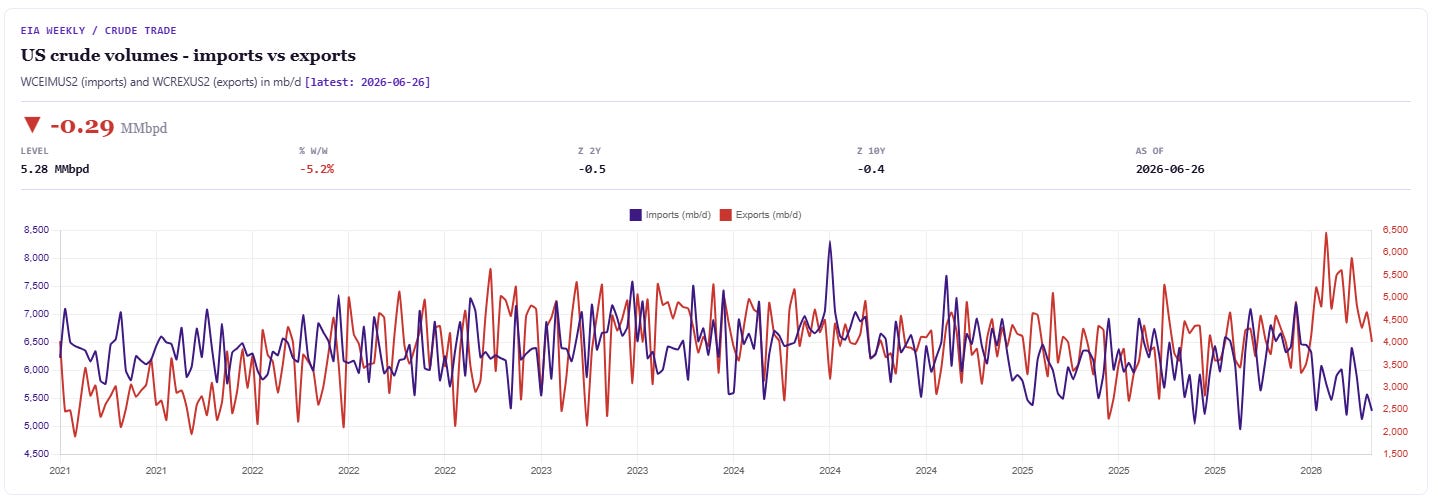
US Exports are receding as the emergency softens.
China has not returned to the market as buyer and in fact is cancelling shipments out of Middle East Gulf (MEG). China quietly slashed its oil imports by 4.9 million barrels per day in June alone. Eric Nuttall claims they are down 450m barrels overall, which by my maths, doesn’t work at all. I see they are out 147mb. Lots more in depth below in ‘China’ section.
Amsterdam-Rotterdam-Antwerp (ARA) commercial stocks rise 13% in June.
According to Marinetraffic.com,108 verified vessel transits through the Strait of Hormuz between 3 and 5 July
Saudi has dropped their OSP (official selling price) -$11 MoM, the largest drop since COVID. This is in an attempt to convince back buyers now that ‘It is over’…..
For all of the bluster of the war, the simple fact is the strategic stocks into market were and are well supplied since mid-May in the G7. See where they are at right now below in ‘Global stocks’.
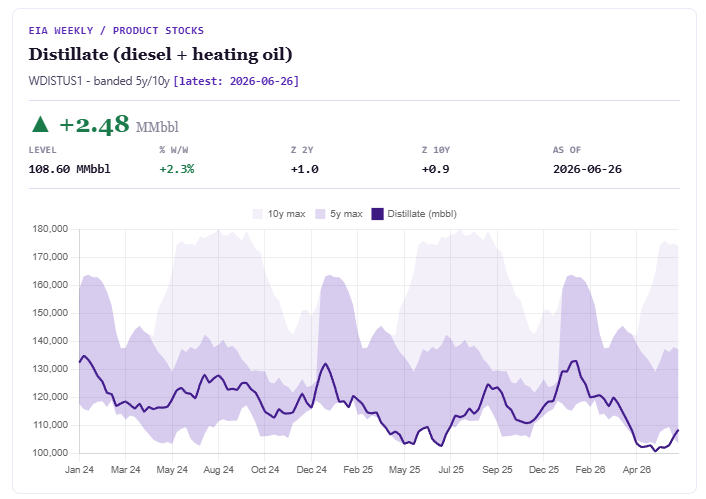
This remains to be the case, however should there be another prolonged closure, these reserves will be released again but at greatly reduced levels. We are continuing to draw down on commercial stocks at Cushing WoW; however, refiners are flat out meeting demand for product. The distinction between ‘meeting’ and ‘trying to meet’ here is significant. The largest upside risk to oil prices is where we see distillates start to draw rather than build. In speaking to this fear, the latest EIA data was a distillate build.
As is with these types of situations in markets, the horror show becomes the greatest talking point and therefore, the greatest fallacy. This happens by way of everything under the known sun getting priced in immediately, then the risk gets priced out. To explain this in easier terms.
Once the market knew there was 400mb of strategic reserves to be released, it could not achieve any new high until those reserves were 100% drawn down, or the war took a much more aggressive form. Risk occurred and was dealt with. So the trade becomes sell the headline. Sure, it becomes a mainstay talking point for weeks and months while it gets worked out, but talking heads don’t make good trades.
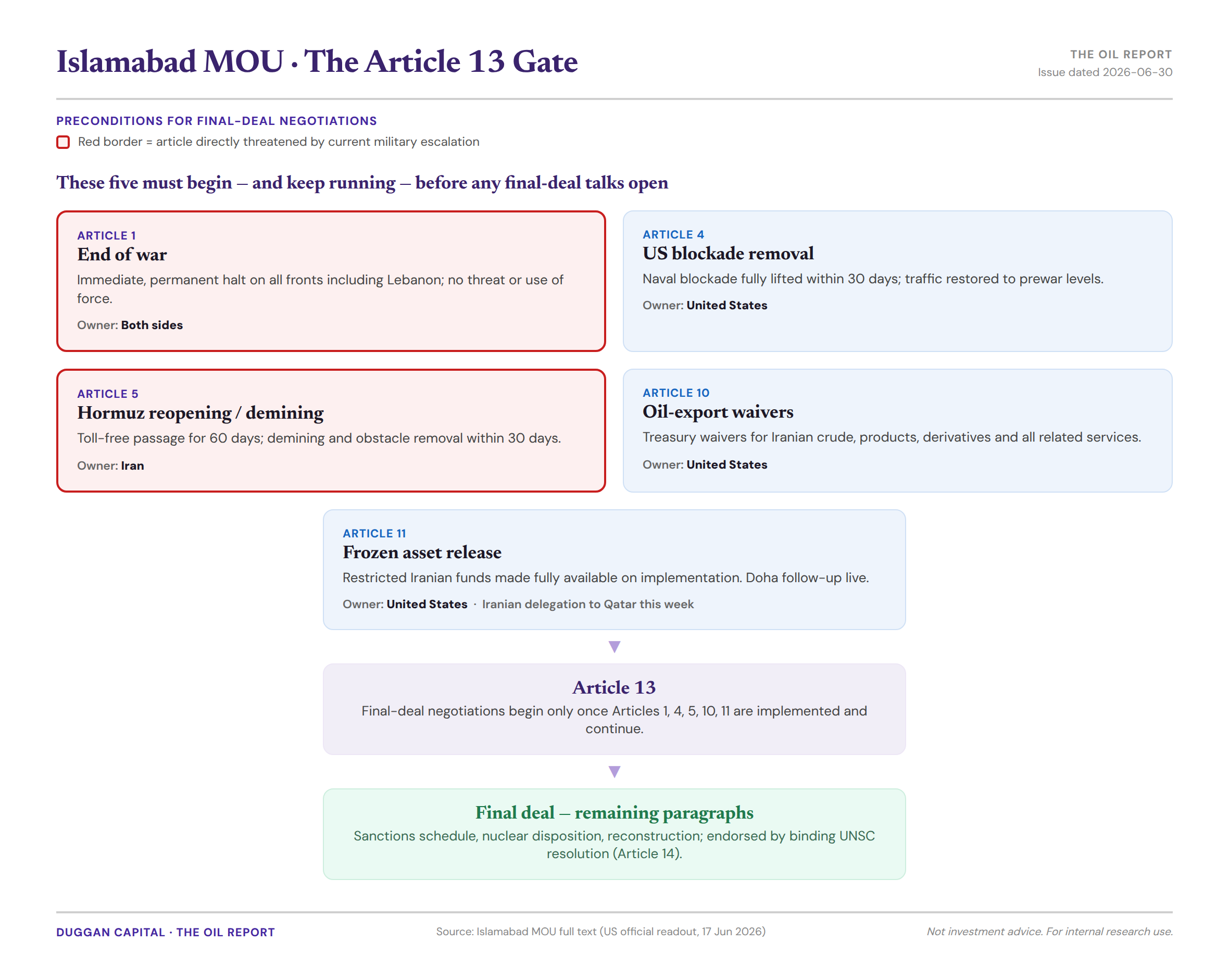
Negotiations / The Article 13 gate
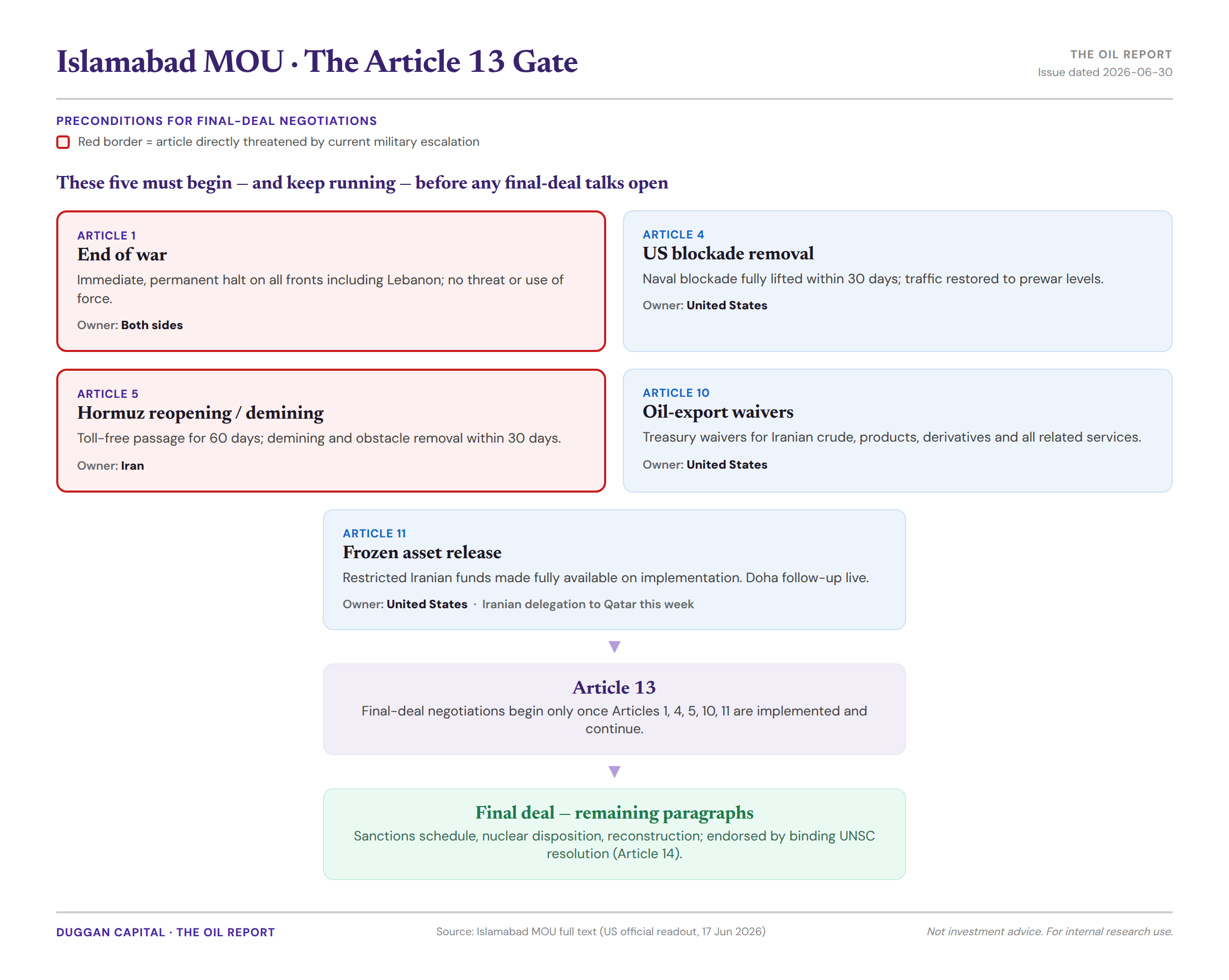
After signing this MOU, Iran and The US have made very good headway towards their MoU goals. Articles 4,5,10 are all but complete, with Article 11 currently under discussion on the final $6billion in Doha. This is strong progress. 3 steps forward have led to one step back and forth regarding the closure of Hormuz. Essentially, Israel are trying to keep article 1 open with war in Lebanon, thus then upholding the possibility of closure of the straits again (Art 5). At the time of writing this, Israeli fighter jets carried out an airstrike on the town of Baraachit in southern Lebanon, according to Press TV/The four.
Article 1 — End of war. Both sides declare immediate and permanent termination of military operations on all fronts including Lebanon, and undertake not to initiate any war or military operation against each other, refraining from the threat or use of force. This is the one “Operation Blue and White” and the late-June US strikes/Iranian missile retaliation directly threaten. Military Times
Article 4 — US naval blockade removal. Immediately on signing, the US begins removing its naval blockade and any impediments against Iran, and fully ends the blockade within 30 days; vessel traffic restored in proportion to prewar levels; US removes forces from Iran’s proximity within 30 days after the final deal. US obligation.
Article 5 — Hormuz reopening / Iran demining. Iran arranges safe passage of commercial vessels toll-free for 60 days only; traffic starts immediately; demining and removal of technical/military obstacles instated within 30 days; Iran to negotiate future Hormuz administration with Oman. Iran obligation — and the 30-day demining clock is the one your project memory flags against the Pentagon’s 6-month assessment.
Article 10 — Treasury oil-export waivers. Immediately on signing and until sanctions termination, US Treasury issues waivers for export of Iranian crude, petroleum products and derivatives, plus all associated banking, insurance, and transportation services. US obligation — this is the one that actually puts Iranian barrels back on the water legally.
Article 11 — Frozen asset release. US makes Iran’s frozen/restricted funds fully available upon implementation; procedures agreed bilaterally during negotiations; funds usable for any beneficiary designated by Iran’s central bank. This is what the MFA said the Doha delegation is going to Qatar to follow up on.
Global stocks
Below, I cover global inventory stocks, China, this week’s Net Net, The Brent COT and Trade section.