



In this report: After the midterms dealt Republicans a blow, the market priced out strikes on Iran and TTF lost 18% in a week, but the shortage didn’t leave with the premium. The polar vortex is breaking down and NOAA’s outlooks show the first signs of cold, while funds in $NG stay at their most short in at least two years.
Last week.
HH +3.4% (+$0.1) Open $2.890 High $3.040 Low $2.839 Close $2.998
TTF -17.7% (- EUR 18.36) Open EUR 104.10 High EUR 104.10 Low EUR 83.56 Close EUR 85.59.
Articles
Iran Opens Strait of Hormuz to China and India as U.S. Blockade Continues
Washington has approved the draft memorandum of understanding
View
Mixed Signals From Washington
Coming into the midterms, it seemed highly likely that strikes would resume immediately after. The market was pricing these attacks with TTF reaching over 100 EUR. On Monday the 2nd of November, a day early, we heard reports of the US bombing Qeshm island however this wasn’t the immediate continuation of attacks people were waiting for.
Last week we reported how, considering the market was pricing so confidently for attacks, each day that passed without attacks would push TTF prices lower and lower. Sure enough, we heard very little in the way of concrete decisions following the bombing of Qeshm island. We were stuck in a rollercoaster of being told “attacks are likely” then “attacks are unlikely” followed by “attacks are likely again”. We have heard those two lines so often that they barely move the markets, people want more concrete evidence. The real market mover came on Tuesday as Washington approved Iran’s memorandum of understanding. News like this in a market pricing confidently for attacks causes violent volatility, and that it did, with price dropping over 9% in under 10 minutes.
War or no War, Europe is STILL short.
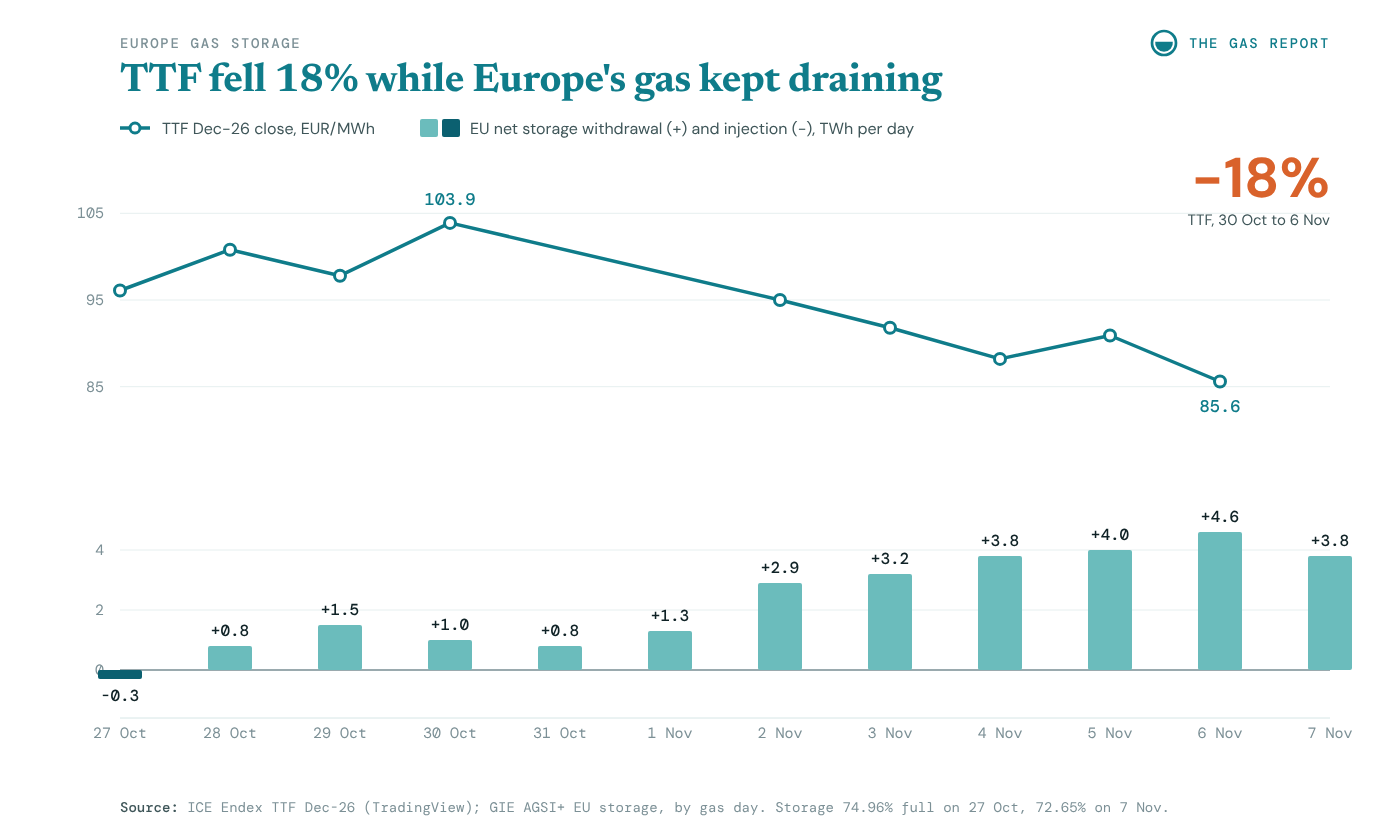
TTF lost 18% last week, but the shortage did not leave with the strike premium. EU storage peaked near 75% on 27 October and has fallen every day since, to 72.65%, according to GIE. Net withdrawals went from 0.8 TWh a day to 4.6 in nine days, and winter has barely started. Another piece of news we got on Tuesday, this time from Iran, was that they where going to open the Strait of Hormuz to India, China, Iraq and most importantly, Qatar. In an ideal world this would help Europe’s shortage, however Qatar can’t simply press a big green export button and have flows back to normal. The heavy attacks they sustained in March seriously hindered their export ability and reports claim it could take over three years for Qatar to return to normal production.
Even after the fall, TTF is about €25 above its five-year average for this week. The market priced out the strikes, not the shortage. It is also important to remember, although the market is pricing out strikes, that doesn’t mean strikes are impossible or even that unlikely. We have not had any news we haven’t heard several times before. We fell particularly hard this week not because a deal is looking so certain, but because attacks were looking so certain the week before and failed to come.
Henry Hub: Weather
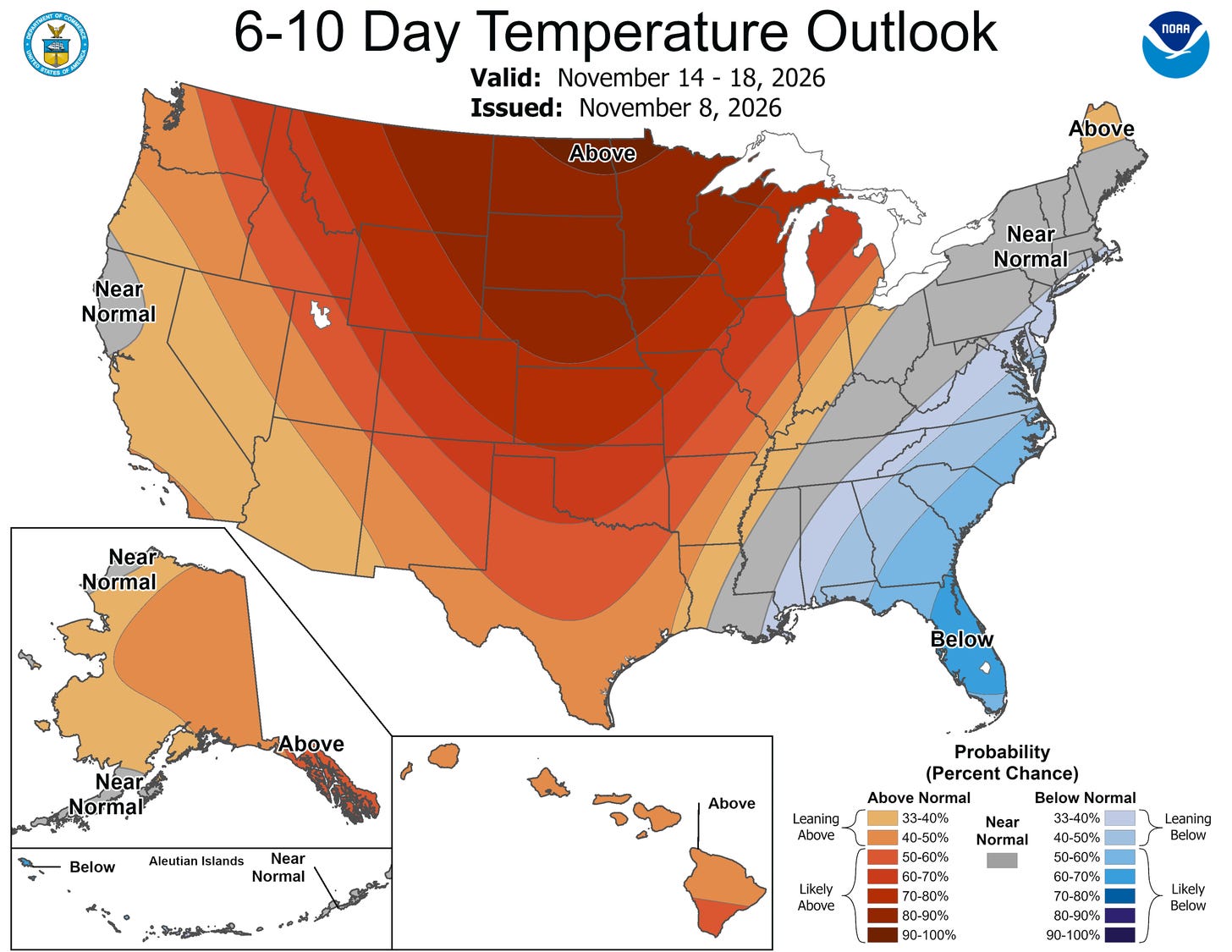
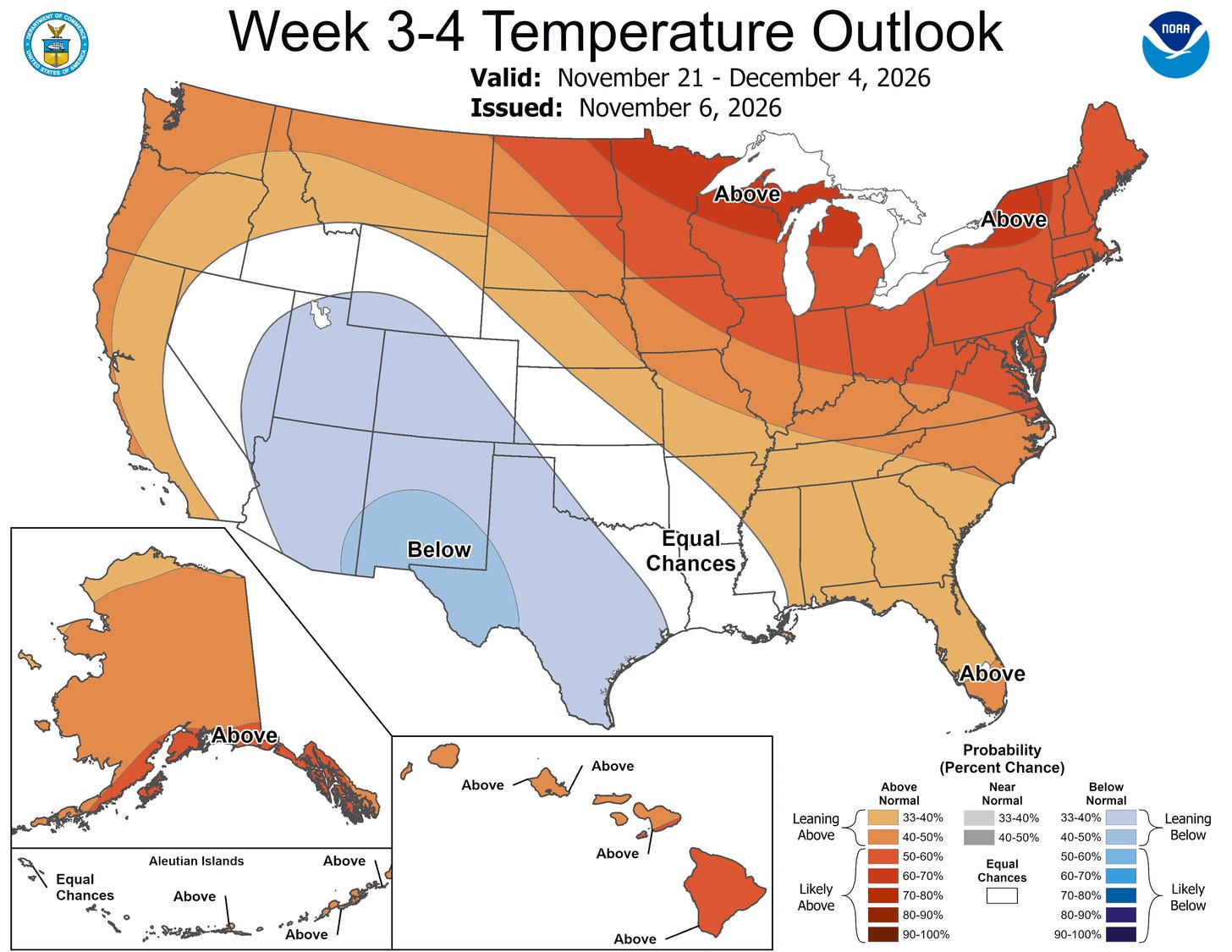
The polar vortex is breaking down and it’s time to start putting on your winter coats. The cold we flagged last week is starting to show up in its outlooks. Last week’s maps had no below-normal area anywhere in the Lower 48. The 6 to 10 day outlook now has the eastern US near to below normal early in the period, with the Southeast coast leaning coldest. By 16 to 22 November a trough moves into the Rockies and NOAA favours near to below normal across much of the West. The week 3 to 4 outlook leans below normal over the Four Corners and much of Texas, and NOAA says some models bring colder air into the Southeast in week 4. NOAA ties that pattern to El Niño creeping along the southern tier more than to the vortex itself. With funds at their most short in two years, cold arriving in the forecasts is the last thing they want to see. The vortex is breaking down, and the cold is arriving from the west and south.
EIA Report
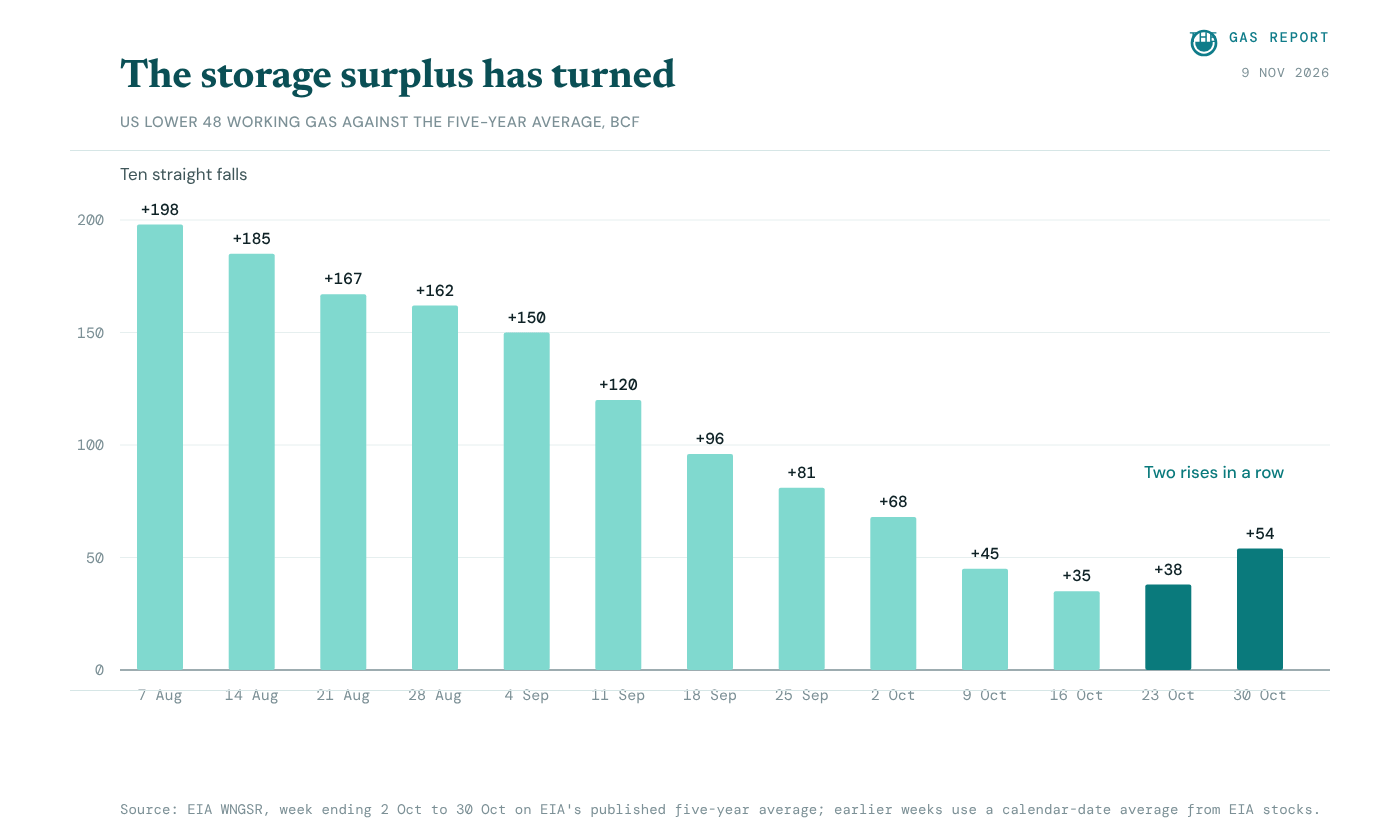
The 77 Bcf build for the week ending 30 October was 4 Bcf below the 81 Bcf analysts expected (Teleborsa), but 16 Bcf above the five-year average of about 61 Bcf. Stocks reached 3,801 Bcf, 54 Bcf (1.4%) above the five-year average and 109 Bcf below a year ago, according to EIA. The surplus grew for the second week in a row, up 16 Bcf from +38 Bcf, after ten straight falls from +198 Bcf on 7 August. South Central added 40 Bcf, the most of any region. That is two rises in a row, so this is beginning to look more like a turn, not a blip. More in the EIA Gas Inventory.
The Net Net
Calendar: Mon 9 Nov: Qatar’s prime minister meets Trump in Washington on the Iran talks. Tue 10 Nov: EIA Short-Term Energy Outlook. Thu 12 Nov: EIA storage report for the week to 6 Nov. Fri 13 Nov: CFTC COT report. Thu 19 Nov: NOAA’s monthly and seasonal outlooks.
Below you get the COT for NYMEX Henry Hub and ICE Endex TTF, then Trade.