In this report: What a barrel costs once it has been moved, what the Brent and WTI curves are pricing, Hormuz flows, and positioning
Last week: Brent +5.18% (+$5.41). O $104.95 H $110.00 L $102.33 C $109.95
Articles
Last weeks EIA inventory report- The Oil Report.
Iran urges US to accept proposal to reopen Strait of Hormuz
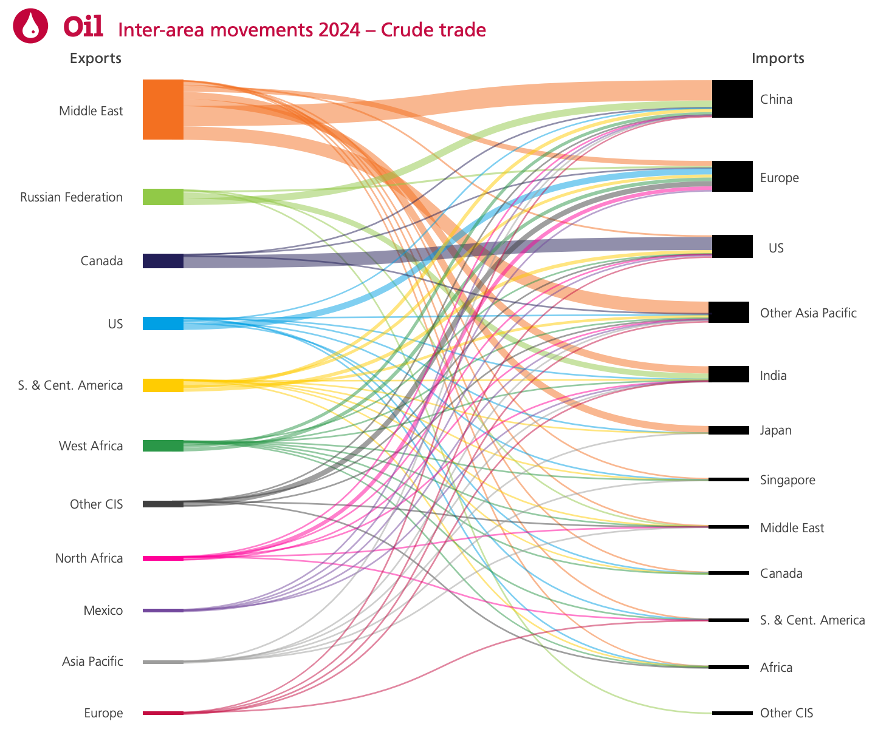
Sky-high tanker rates change crude trade flows
Yemeni army rosters filled with ‘ghost names,’ leaving Mocha vulnerable to Houthi takeover
Houthi military sources say that investments within Saudi Arabia are unsafe, Saba report
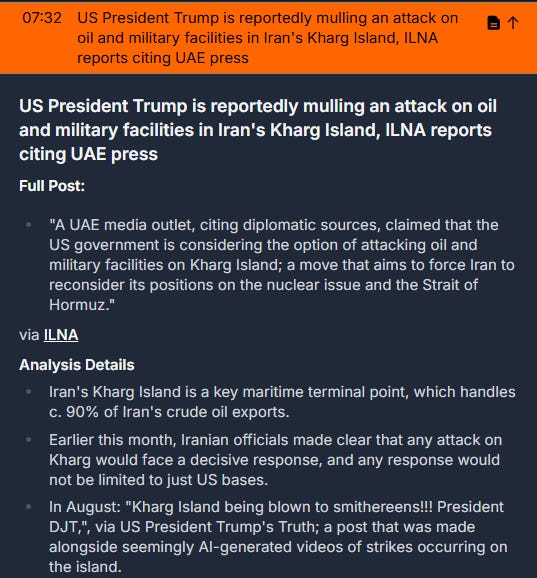
Exclusive: US considering using ‘mother of all bombs’ against Iran, sources say
IRS provides dyed diesel fuel relief related to excise tax following President Trump’s Executive Order
Oil transfers off India’s west coast surge as Gulf shipping congestion worsens - The National
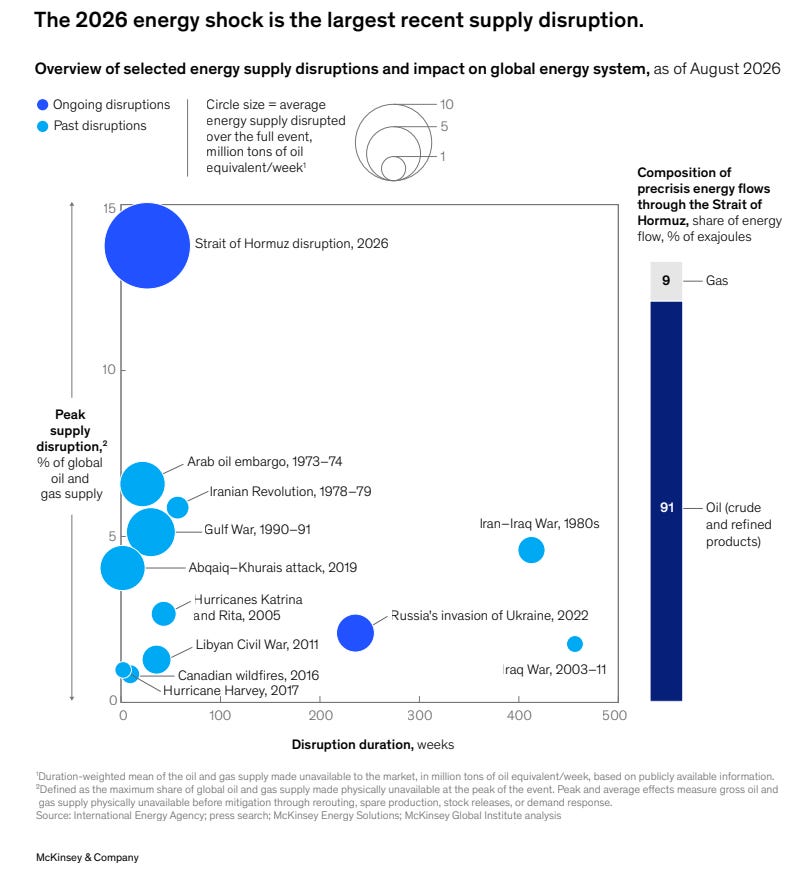
Aftershocks: Energy security beyond the Strait of Hormuz crisis -McKinsey
Why Oil Hasn’t Hit $200, and What Happens Next | Javier Blas - Oil Ground Up, Rory Johnston, recorded 13 Oct
View
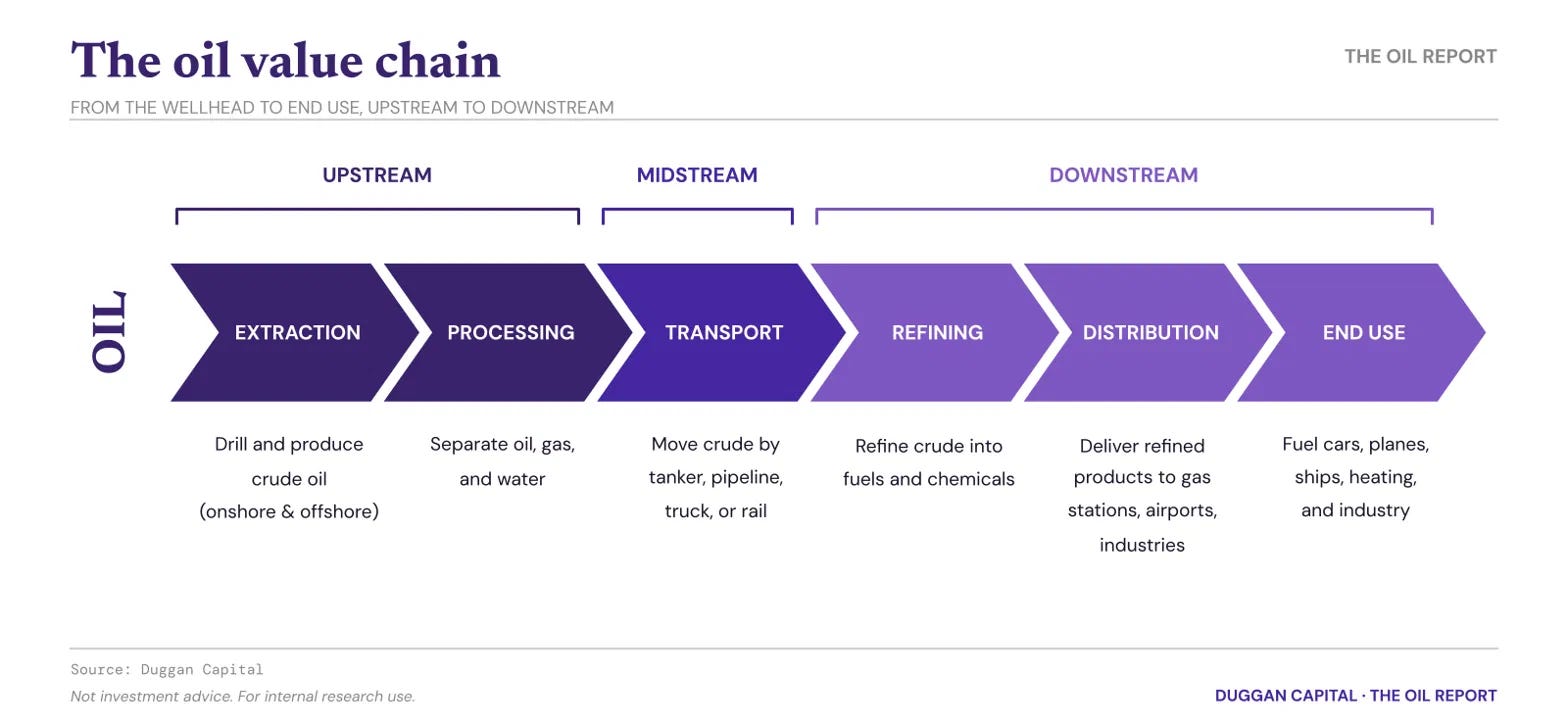
It is clear that we are seeing this Iran war creeping its way across the oil value chain from both processing and refining, to a squeeze in the midstream.
Brent settled $109.86 on Friday, the highest settle since 19 May. The markets are shifting focus now to inflation impact. Evidenced by last week’s CPI and PPI beats in the US. Higher for longer expectations on both energy and interest rates are bedding in. Crude tightness has already transmitted downstream into a very constrained refining utilisation picture and the higher prices we see across the product stack for distillates and petroleum around the world. The next element now biting in, is shipping rates.
We have a lot of refining capacity, but just in the wrong places ie. outside Hormuz and inside Russia. The crude that gets to refining installations worldwide is coming at a steeper and steeper price to the consumers and the latest premium is shipping cost. On average, a crude tanker is running a day rate of $805,000, with some rates quoted as high as $1.3m for no doubt a risky ‘Hormuz run’.
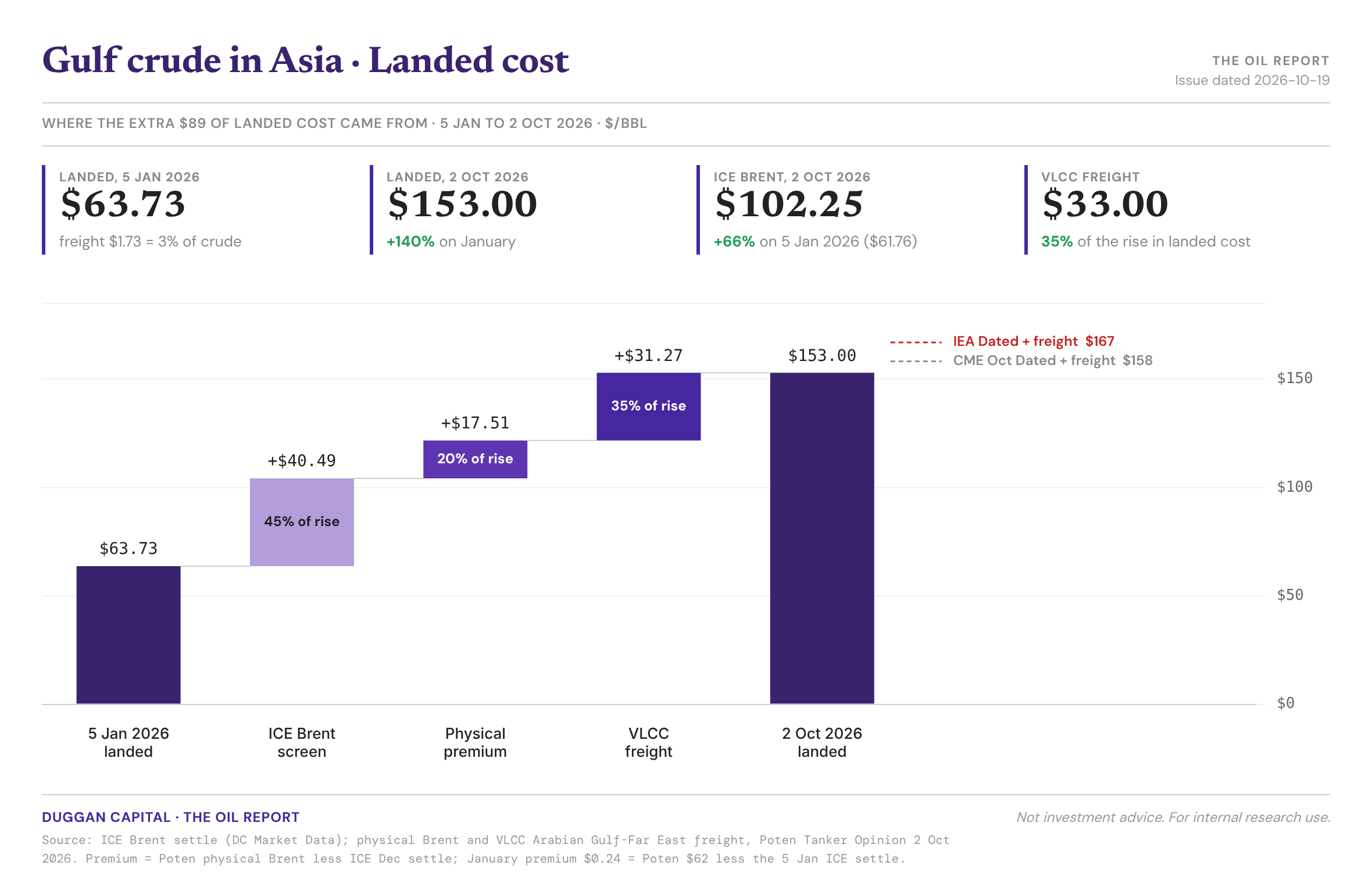
Here is what a refiner in Asia pays. On 2 Oct a barrel of Gulf crude cost about $153 landed: $102.25 for Brent on the ICE screen, $17.75 of physical premium on top, and almost $33 of VLCC freight to get it from the Persian Gulf to the Far East. In January, the same barrel cost about $64, and freight was $1.73 of that. ICE Brent was up 66% over the stretch. Landed cost was up 140%. Using IEA’s Dated Brent of about $134 in place of the physical premium and the bill is $167, up about 160%.
I won’t get into the weeds on this because believe me there are deep weeds with crude tanker logistics and trade. There is also the layer of ‘walk up shipping’, whereby tanker traders will reroute ships in mid-transit and arb the savings. It also occurs with trading oil mid-pipeline. So let’s get back to the point.
The price gap from inside the strait to outside is about $35 a barrel. Getting across costs about $20. A trader keeps $10-15 on a 2 million barrel VLCC, which is $20-30 million a cargo. Vitol’s Ian Taylor used to say a good year was 1.5% on turnover and 50 cents a barrel was a great trade.
Shipping is now a MAJOR addition to the price of a barrel that is spreading across the entire futures curve. Read The Net Net section below.
Discounts
Sellers are paying dearly for this shipping risk and logistics problem. Iraq offered October loading Basrah Medium at a $34.50 discount. Basrah Heavy at $37, against under $30 in August- source: Rystad, via The National.
Aramco cut its November Arab Light price for Asia by $3-5 a barrel below the Oman/Dubai average, the widest discount since 2020. QatarEnergy cut its November crude prices by $3, to $8 below (Qatar Marine) and $7.50 below (Qatar Land) the Oman/Dubai average. - source: The National, citing a pricing document. Murban traded as much as $26 over Dubai swaps in late September and has eased to about $15. - source: Rystad.
If the price of a moped goes up 1900%; as a pizza business, you make less per pizza. The delivery guy on his moped is laughing! It becomes clear you would rather be in the delivery business.