



In this report: $TTF broke €100, outbidding Asia in the fight for LNG cargoes, while $NG slid another 5% with funds the most short in at least two years. The midterms are tomorrow so a decision on Iran must follow. A polar vortex is bringing the cold back into play.
Last week. HH -5.0% (-0.152$) Open $3.006 High $3.092 Low $2.830 Close $2.898
Last week. TTF +10.8% (+EUR 10.15) Open €93.90 High €104.36 Low €93.21 Close €103.94
Articles
Banks Up, Brent Down- The Oil Report
Polar Vortex Split Forecast: The Earliest Stratospheric Warming on Record Is Coming
Polar Vortex Forecast: Live Maps, Latest Updates, and the Winter 2026/2027 Outlook
Middle East on Edge as Fears Mount that Iran War Could Restart After the Midterms
View
The Midterms
As we said last week, the date to watch is November third, i.e, the midterms. Trump has been preoccupied trying to win the battle at home over the past few weeks, headlining 25 rallies this month, for races he considered “very important”. Regardless of the outcome of the midterms, we’re waiting on Washington’s decision regarding the Iran situation. Iran are still willing to come to the table, but under their terms. Will Trump answer by coming to the table or by blowing up the table? The market was evidently pricing the ‘blowing up the table’ option last week but with a near 6% drop in price this morning over hopes of diplomacy, the market is priced somewhere in the middle. This means strikes would still drive price higher but each day we go without strikes the market will fall lower.
When Rubio was pushed to comment on Iran, he showed his distaste at stating “The Iranian regime is basically arguing, ‘Unless we get what we want, not only will we blow up ships, but we will destroy the energy infrastructure of our neighbours and the entire region’ ... That’s not normal behaviour, but we are there to help protect against it.”
Looks to me like the pot calling the kettle black but anyway…
The Bidding War
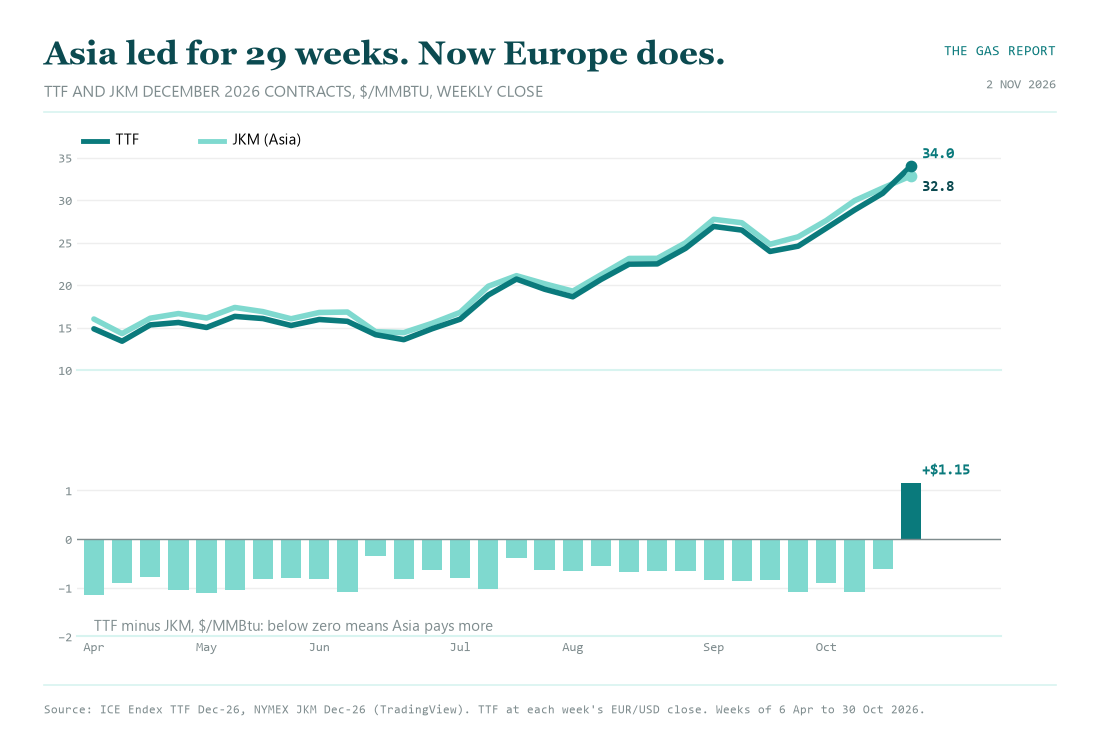
Last week Asia was paying more for LNG than Europe. This week that flipped. TTF touched €100 on Wednesday and finished the week about a dollar above JKM, the Asian benchmark, at roughly $34 against $33. That matters because a cargo goes to whoever pays the most, and this week that was Europe. It had to be. Storage peaked at 74.96% on the 27th and has fallen four days running. Germany is only 61% full. Cheniere puts Europe’s winter need at about 69 Mt of LNG, just to match last year’s demand and storage levels coming out of winter. Despite a 10% increase in the price of TTF, US exports of LNG remain in line with last week’s figures (between 20.6 to 21 bcf/d). They can’t send anymore, with the profit margins this wide, if they could, they would. Europe and Asia’s combined demand has risen far above the quantity the US can supply. So it’s now a case of who will pay more for the same gas and clearly, Europe has risen to the challenge with TTF closing above JKM on the week for the first time in at least six months.
Henry Hub: Weather
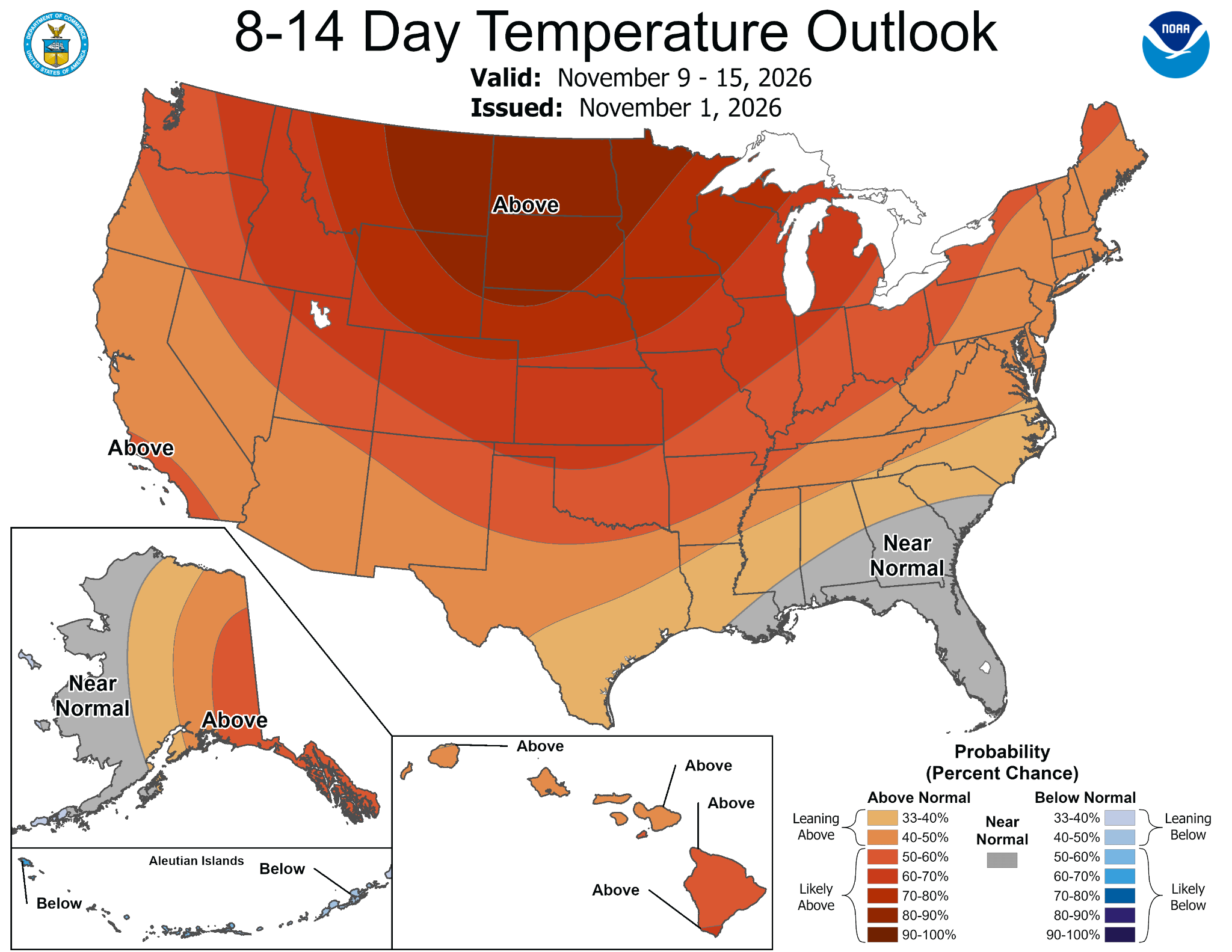
This is the most interesting weather section we have had in a while. Up to now we have reiterated week in week out that a cold snap would shock the market higher. The market was always pricing a warm winter, but it was also cautious of a surprise cold snap. In last week’s report we discussed how the risk premium of a surprise cold snap is now gone from the price of $NG. Interestingly, it is now, after the market gave up on the cold snap, that we are starting to see the genuine possibility of one. The 6-10 day NOAA weather outlook is showing more of the same; above average temperatures all over. The 8 to 14 day forecast is more interesting. We start to see the above average temperatures drop off in the southeast. The NOAA points the cause of this towards a dip in the jet stream over the East Coast by the 9th to the 10th of November. However I didn’t say this was the most interesting weather section we have had because Florida will be a little chillier!
The bigger risk is the polar vortex split! Andrej Flis of Severe Weather Europe forecasts it breaking down around the 4th of November, the earliest on record by at least three weeks, and the European model gives that a 96% chance (the American model 71%, the AI model 37%). The vortex is a ring of winds that keeps the coldest air bottled up at the pole, and when it breaks, that air can spill south. Funds are already at the 100th percentile of crowded short, and last week we watched them give up on any cold spell. That means this doesn’t need to be a deep freeze, just an unexpected cold snap will be enough to create the short squeeze, and we’re looking at this kicking in between the 8th and 10th of November. Paired with the dip in temperatures the NOAA forecast on the 9th to the 10th, this could be an interesting time frame to watch.
EIA Storage
The 80 Bcf build for the week ending 23 October was 5 Bcf above the 75 Bcf analysts expected (Investing.com). The five-year average for the week is about 77 Bcf. Stocks reached 3,724 Bcf, 38 Bcf (1.0%) above the five-year average and 147 Bcf below a year ago, according to EIA. The surplus grew for the first time in eleven weeks, up 3 Bcf from +35 Bcf and ending ten straight falls from +198 Bcf on 7 August. A 3 Bcf move is a pause, not a turn. The next EIA report will tell us whether this was a blip or a sustained change. South Central added 43 Bcf, but at 28 Bcf below its five-year average it is still the only region short. More in the EIA Gas Inventory.
The Net Net
TTF: TTF gained nearly 11% last week, and as of this morning it has pulled back about 5% on hopes of diplomacy. That tells us two things. Part of the risk premium has already come out, so strikes this week would be less priced in than they were on Friday. And it shows how quickly that premium goes on any sign of a deal, or just a lack of attacks. Underneath it Europe is still short: Cheniere puts its winter need at about 69 Mt of LNG just to match last winter and finish at 28% storage, and even if the Strait reopens, flows won’t be back on day one. A deal would gap it down, but I wouldn’t expect it to go all the way back. The April ceasefire is the precedent: down 27% in eight sessions, then up 16% in five. Deals gap it down, shortages bring it back. If we do get a deal, depending on how far we fall, we would be weighing up buying opportunities based on whether the market is undervaluing the importance of Europe’s storage shortage; but of course, if this happens, we will be here to cover it.
Henry Hub: An absolutely critical thing for any of us monitoring COT reports on any market need to keep in mind, is that a crowded market in itself isn’t a reversal indicator. A crowded market can always get more crowded. And even now, at the 100th percentile crowded short, we could still see lower prices, more longs being cut and more short positions being added. What we need is the catalyst. Our lean is to the upside. We’re looking at the polar vortex to be this driver. The bad news is a polar vortex split this early in winter is unprecedented, so not by any means simple to estimate impact, scale or exact timing. The good news is we don’t need to worry about it having a massive impact. With this crowded of a market, with no bullish catalysts in weeks, all we need is a small drive up triggering a short squeeze. The falsifier to this is the polar vortex cold coming later than expected and another above average build on storage.