


Please give a like and a share if you like this article.
In this report: A grand view and primer on global refining and a look at my internal price models. COT Report for Brent. and trade outlook.
Last week. Brent +5.38% (+$4.78) Open $88.89 High $94.83 Low $88.01 Close $93.60


Articles
Trump lifts summer gasoline restrictions early as prices remain stubborn
Canada says it will match US tariffs ‘dollar for dollar’
U.S. bond intervention is like ‘paying your mortgage with your credit card,’ JPMorgan’s Sullivan says.
What the 2026 Midterms Could Mean for the Markets
Trump administration refunds $100bn in tariffs struck down by Supreme Court
International contention continues as eight more countries condemn Israel’s E1 settlement plan
Middle Eastern supply recovery postponed to early 2027
Pentagon reportedly concludes no military plan can guarantee Hormuz safety and stability
Stripe says "the singularity" has begun
The history behind the US-Iran conflict
View
America has run out of leverage. They cannot hold a siege from an oil reserve which is at a 1983 low, a national debt at $40 trillion and a bond market that is starting to leak. Out of the 172mb of strategic release oil, there remains 50mb at SPR, with only 12mb of this unassigned. The relief valve is now about to run dry. It is easy to see that Iran has the wind at their back, as the temperature is rising on an administration that has been flying too close to the sun.
Over the last 2 weeks, Iran have stated they will simply wait until the end of Trump’s presidency in Jan 2029. Notwithstanding this, there are further winds blowing against this latest edition of US adventurism. They include….
Strategic reserves depletion.
With the US now down to the last 12-50mb of strategic release oil, it would serve Iran well to continue to hold out, forcing the US to essentially work through this situation without further approved strategic oil.
When the full 172mb is spent, 243mb SPR crude will remain. This leaves 173mb in reserves over the new DOE operational floor limit of 70mb. A fair cushion, but a serious strategic dent in US energy security. The US stepped in (via its reserves) as the swing producer in place of Saudi Arabia. Something not seen since1972, when the Texas Railroad Commission lifted its market-demand production quotas and went ‘‘100% allowable’’, meaning there were no more production caps. By the end of that over production phase, US production was maxed out, leaving wells depleted of pressure and thus production capability. This is when they essentially handed over pricing power to OPEC and became net importers of oil until the shale revolution thirty years later at the turn of the century. It seems destiny, that this will again unfold.
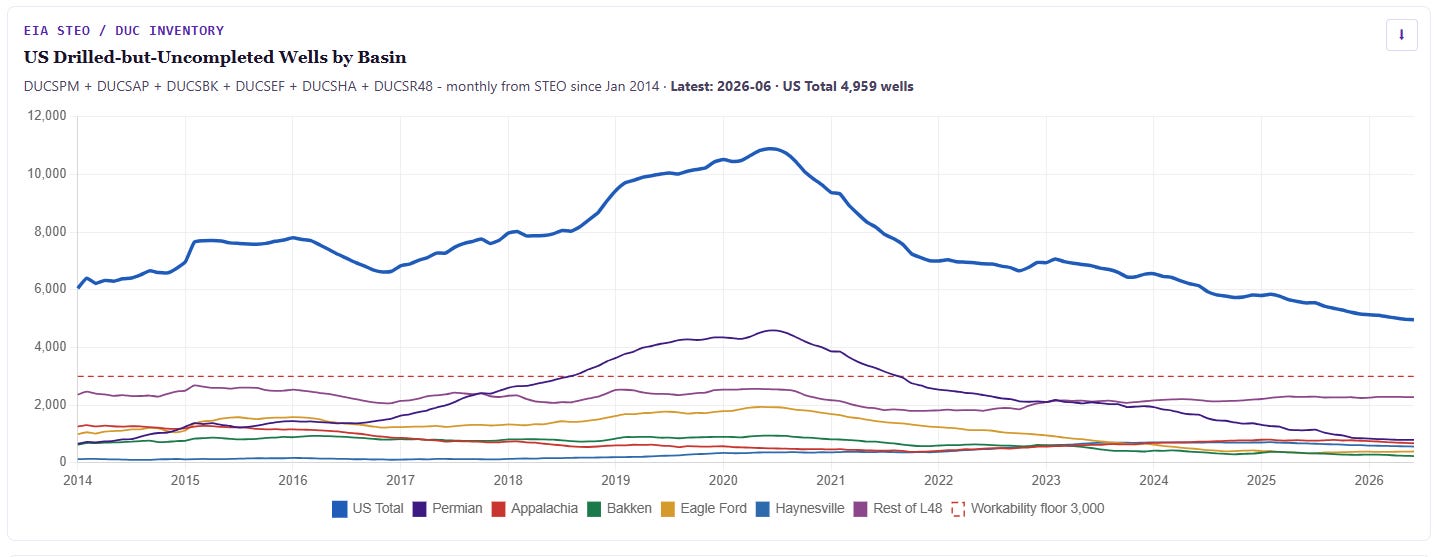
The US production picture is healthy, but there remain question marks over the actual DUC inventories and the shorter life run horizontal wells that come in to replace them.
Global refinery down
Let’s talk Refining. Think of the world refineries as kitchens. Crude oil is the ingredients. Diesel, petrol and jet fuel are the meals. Capacity is the number of ovens you own. Utilisation is how many of those ovens are actually switched on.
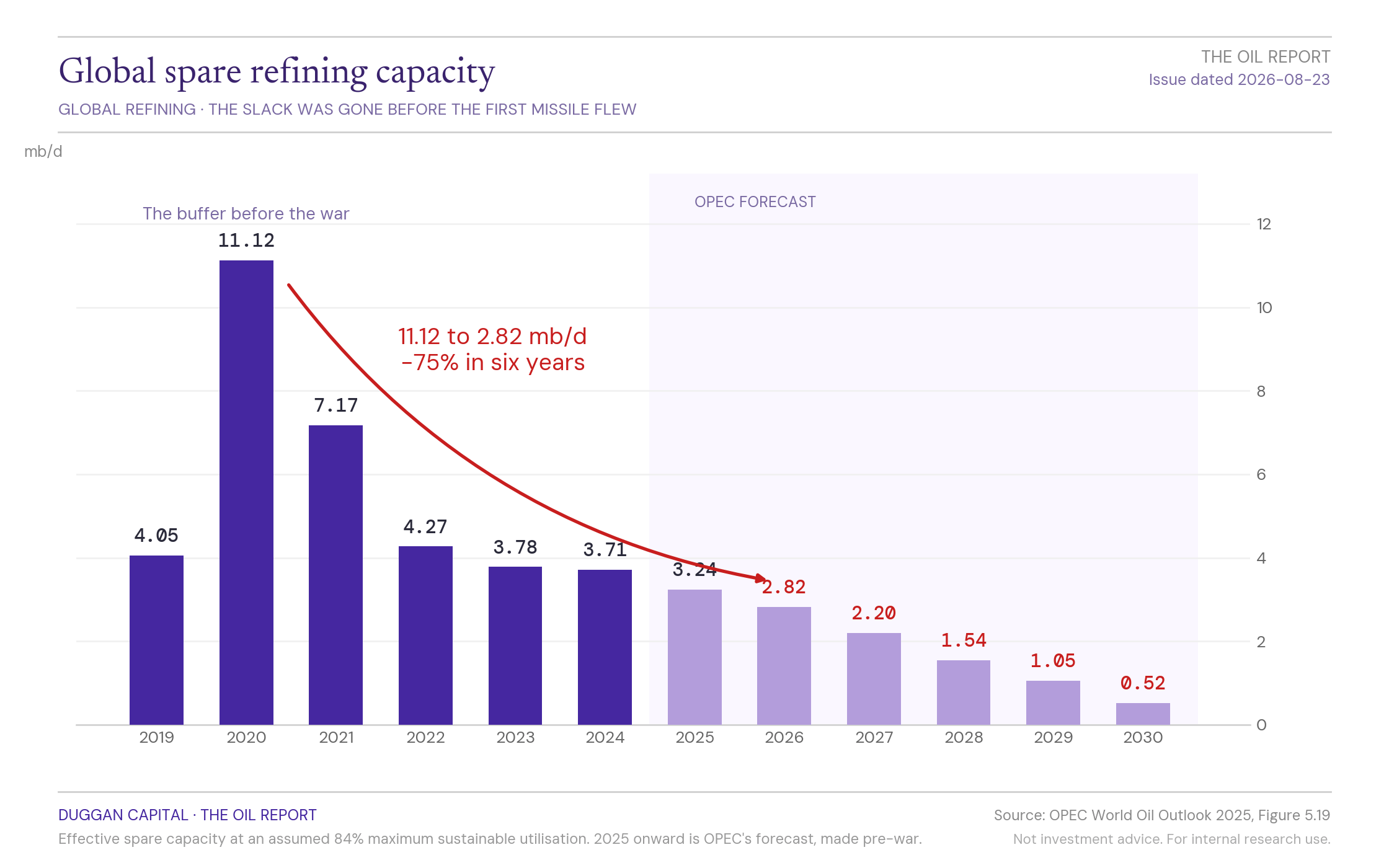
Spare capacity is another dimension. Like a restaurant, kitchens may not run every oven all the time. Keeping a few cold on purpose, so when big groups/orders come in, they can fire them up. That is what is called spare capacity. OPEC puts spare refining capacity at 2.82 mb/d in 2026 against 11 mb/d in 2020, measured at 84% maximum sustainable utilisation.
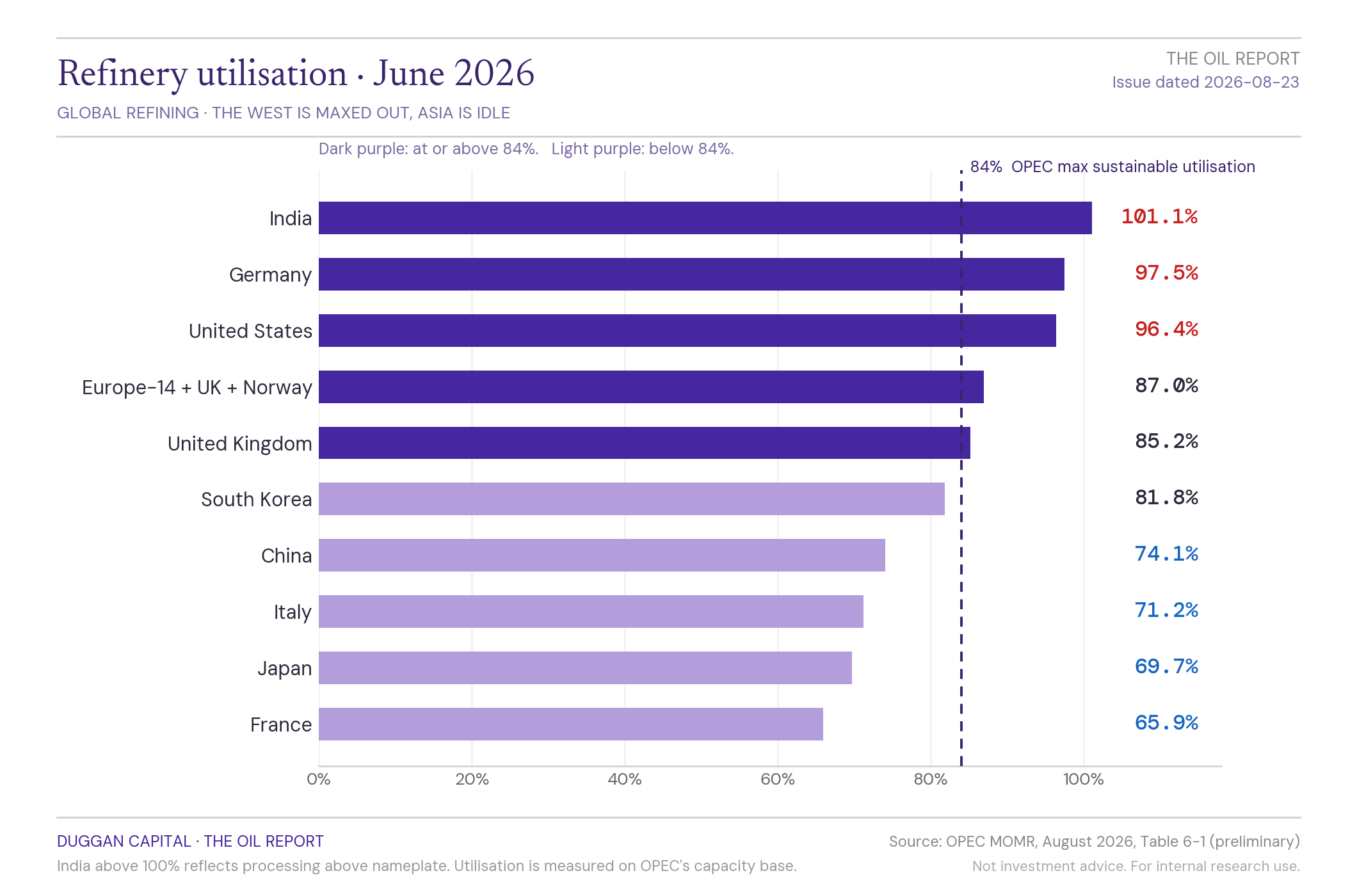
The world owns more ovens that it ever has. New ones in Nigeria, China, Kuwait and Oman in the last two years. What changed is that a lot of the kitchens have gone quiet. American kitchens are running at 96% and cooking like the clappers. Chinese kitchens are running at about 58-74% and the small independent Chinese ones in Shandong, are down to 50%, the lowest in 9 years.
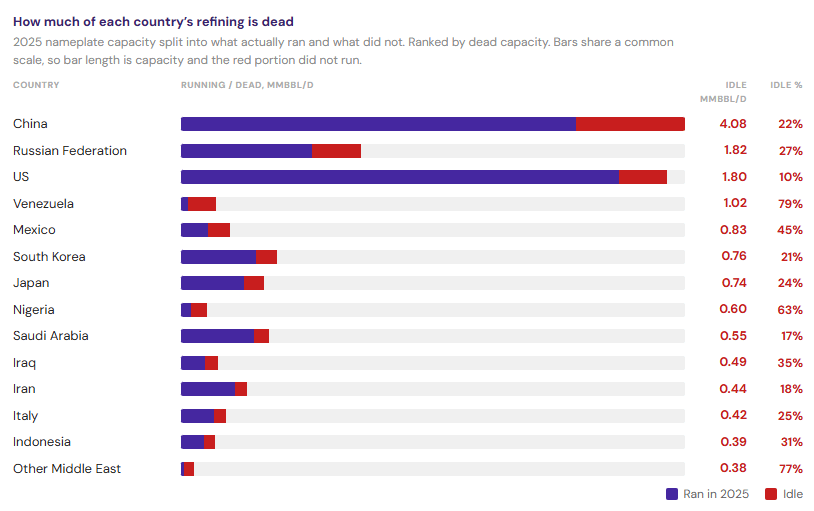
Chinese refiners are quiet because the imports stopped coming, not because demand dropped as most will state. This is where demand destruction is not as it seems. China took in less crude oil in June that in any month since 2016. Beijing told its refiners in March to stop selling diesel abroad.
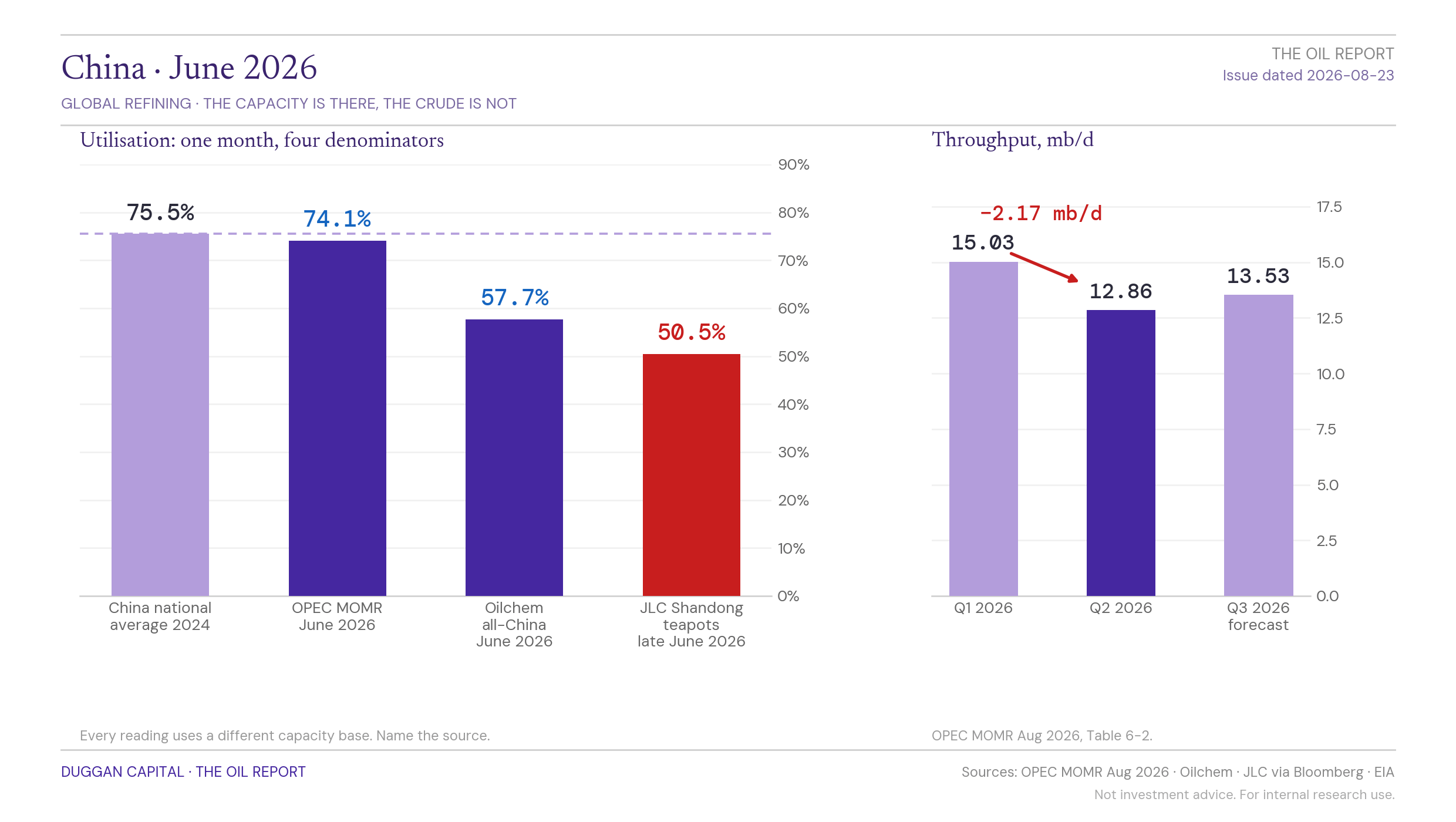
So in short, we are not short kitchens. We are short of kitchens that can get ingredients in and meals out. Global runs fell from 81.3mb/d to 75.9mb/d in Q2 this year. What is happening is the price of the meal goes up (diesel, petroleum), though the price of the ingredients barely moves.
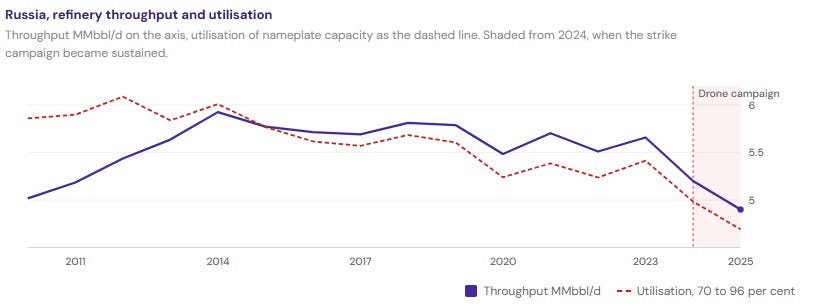
On EIA estimates, Russian utilisation fell from 93 per cent in 2014 to 73 per cent in 2025 and estimated as low as circa 43% in June 2026, leaving 1.82 MMbbl/d idle, already the second-largest pool of dead refining in the world after China
Political pressures
With mid-term elections approaching, Iran can easily play down the clock before an inevitable Democratic resurgence. It looks like The Republicans will at least lose the House, currently holding 219 out of the 435 seats. The Democrats hold 212. The absolute worst outcome will be a Democratic wash that also seems inevitable on the back of an incredibly unpopular and costly war.
The debacle of liberation day tariffs is also now unwinding in a grand way. $100bln of tariffs have now been repaid out of $166bln charged to date. But the worst effects are about to land. And they will be delivered by Mark Carney, one of our times most capable national leaders.
In a national address over the weekend, Carney shot back at the US 50% tariff plan on Canadian goods, with a promise to impose a ‘‘dollar for dollar’’ tariff for US goods sold in Canada. And I’m pretty sure he has the whole of Canada behind him.
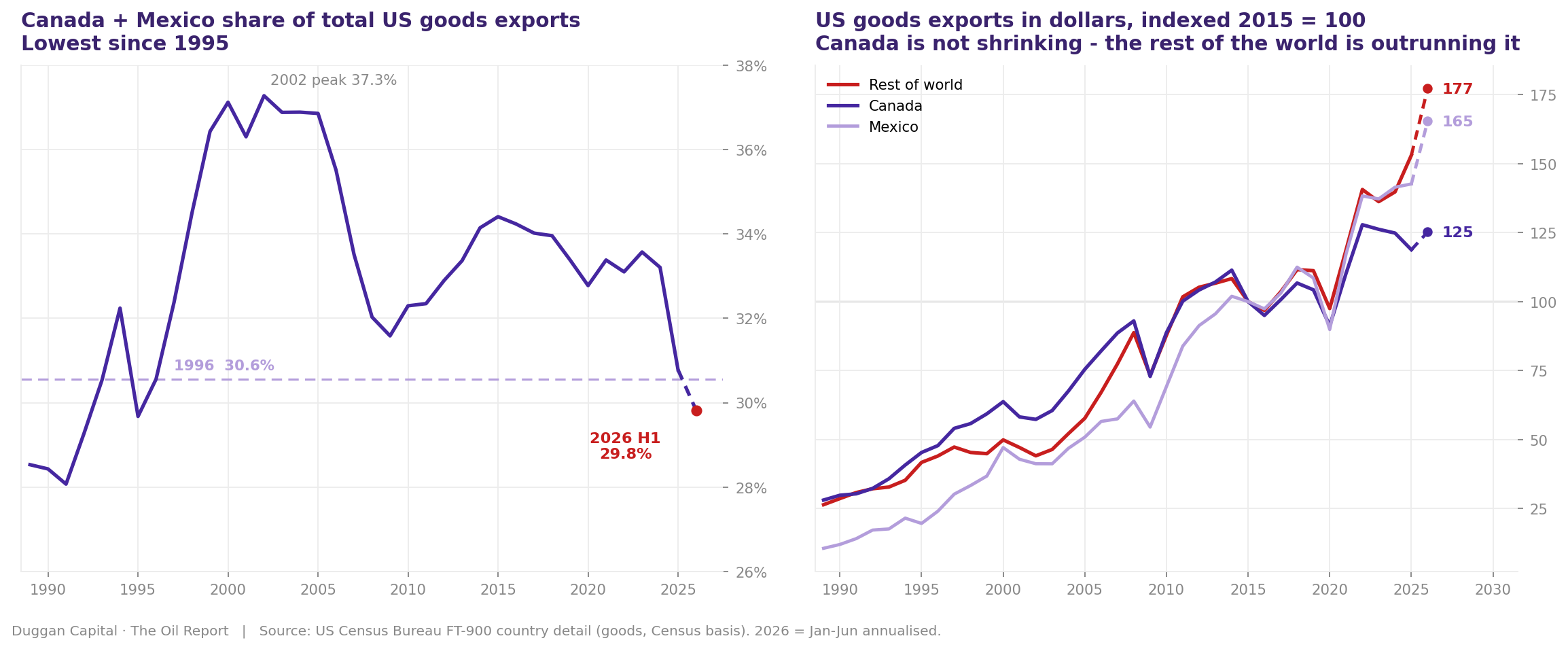
US goods exports to Canada, 2025: $426.3bn. It is important to note that Canadian crude exports are untouched by Carney's promise at this time. US exports to Canada and Mexico fell to their lowest share of total US exports since 1996 (Forbes, citing trade data, March 2026).
Financial pressure
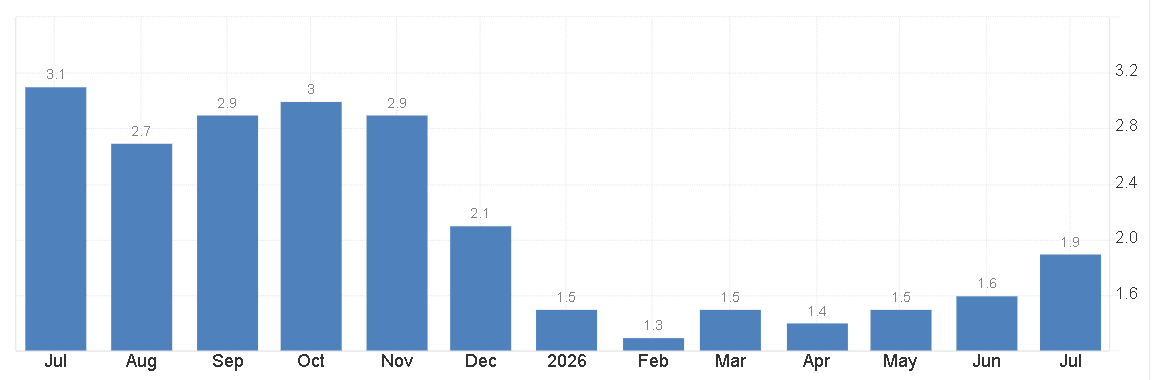
Strategically, The Iran war has boomeranged back to Scott Bessent in the shape of a bond bailout of sorts for Japan. Japan got about 90% of its crude through Hormuz. When Hormuz closed, this created direct energy led inflation in Japan, with CPI moving up to 1.7%. The BOJ then moved rates up in June to 1% from 0.75%. This in turn caused major weakness in The Yen. So the BOJ spent $53bln to prop up the currency. When this had little impact, they picked up the phone to Scott Bessent.
TOKYO: Hey Scott… yep… yep… listen, shut up a second.
Your boy Donnie has really messed us up over here.
Yep… yep… we know, nuclear weapons. Yep.
Hey, Listen. You know those government bonds of yours we have?
…Yep. Oh yeah. Yep, Scott.
Hey……. Scott. Listen, Scott.
Yeah. About the bonds………
[silence]
Oh? Really? You can?
Well… that sounds good.
Five billion, you say?
You’re going to sell some euros?
…Mark our position to market??
Really?
[pause]
…We could do that.
Japan wanted to liquidate their US bond holdings. Scott Bessent marked their bonds to market and gave them the credit in US dollars at the treasury, on the spot.
So Japan got access to the money without having to sell the bonds. Think of it like a reverse mortgage on the bonds. (If you are Irish, you may remember the Anglo Irish bank loans for shares fiasco).
Subsequently, this week gone, long-dated bond yields across the globe spiked up. ie. 10yr to 30yr. Remember, Bonds price down, yields up…..
‘‘This week’s sharp selloff in bonds, particularly at the long end of the yield curve, was a global phenomenon, with yields hitting multi-decade highs in the U.S., Europe and Japan. But, as is often the case, most of the focus was on the spike in Treasury yields, with the 30-year hitting roughly 5.34%, its highest level since 2007.
The potential catalysts for this "long bond" yield surge are varied, including fears about the U.S. fiscal outlook and the huge debt splurge by AI hyperscalers.’’-